


What is State of Charge (SoC) in a Used EV Battery?
State of Charge (SoC) is the battery percentage you see on your EV display. Learn how SoC works, how it differs from SoH, and what it reveals about a used EV.

State of Charge, or SoC, is the percentage shown on an EV's display that indicates how much energy is currently available in the battery. It works like a fuel gauge on a petrol vehicle. An SoC of 80% means the battery currently holds 80% of its capacity at that time.
The key word here is "capable of storing at that time." SoC is always relative to the battery's current maximum, not its original one. If the battery has degraded to 85% State of Health, a 100% SoC reading means the battery holds 100% of a smaller tank. This is where many used EV buyers get misled.
A scooter showing full charge on the dashboard does not mean the battery is in great shape. It means the battery is full. How much that full charge delivers in kilometres depends on the underlying SoH.
How is State of Charge measured in an Electric Vehicle?
State of Charge is measured by the Battery Management System (BMS) using a combination of voltage readings, current tracking and temperature data. The BMS monitors how much energy goes in during charging and how much comes out during riding. This continuous tracking allows it to estimate the current charge level.
There are two main measurement approaches the BMS uses. The first tracks cumulative current flow into and out of the battery over time. The second uses the relationship between battery voltage and charge level, which changes in a predictable pattern for lithium-ion cells.
Neither method is perfectly precise in real-world conditions. Temperature affects voltage readings, and small measurement errors accumulate over time. This is why an EV's displayed SoC can sometimes feel slightly optimistic compared to actual range delivered.
Expert View: SoC accuracy in Indian conditions can drift more than expected due to heat. High ambient temperatures alter cell voltage behaviour, which makes the BMS estimate slightly off. A battery showing 30% SoC on a 42-degree afternoon in Delhi may deliver less range than the same reading on a cool morning. This is normal, not a fault. |
What is the difference between SoC and SoH in an EV battery?
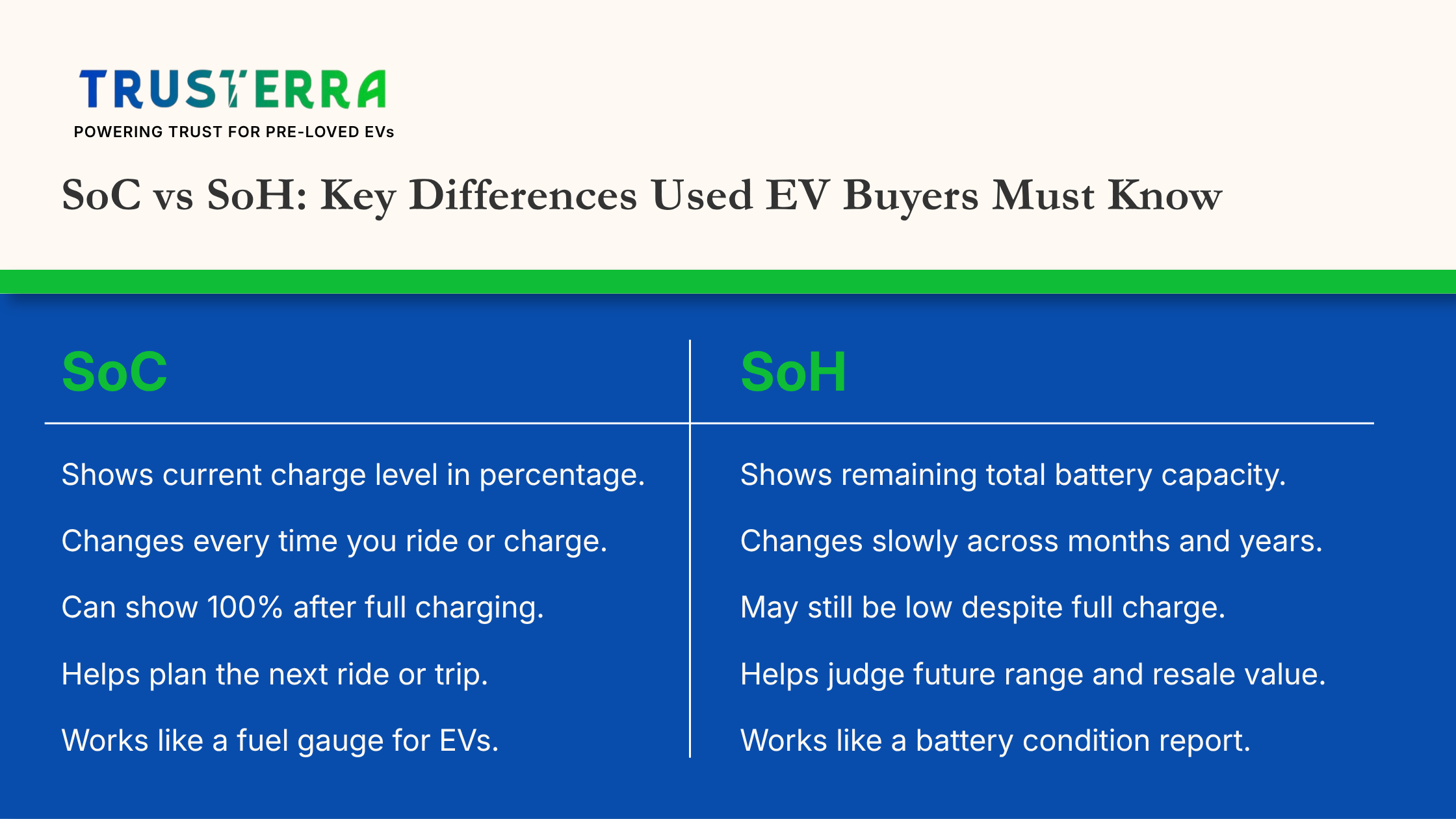
SoC and SoH measure two different things about the same battery. State of Charge tells you how full the battery is right now. SoH tells you how much of the battery's original capacity remains. One changes every time you ride or charge; the other changes slowly over months and years.
The confusion between these two terms causes real problems in used EV transactions. A seller can show a buyer a 90% SoC reading to suggest the battery is in great shape. But if the battery's SoH is 72%, the full charge represents a much smaller energy store than the vehicle originally had.
| Parameter | What It Measures | How Often It Changes | Visible on Dashboard |
| State of Charge (SoC) | Current charge level | Constantly | Yes |
| State of Health (SoH) | Total usable capacity vs. original | Monthly or yearly | Rarely |
How do charging habits affect SoC and battery health over time?
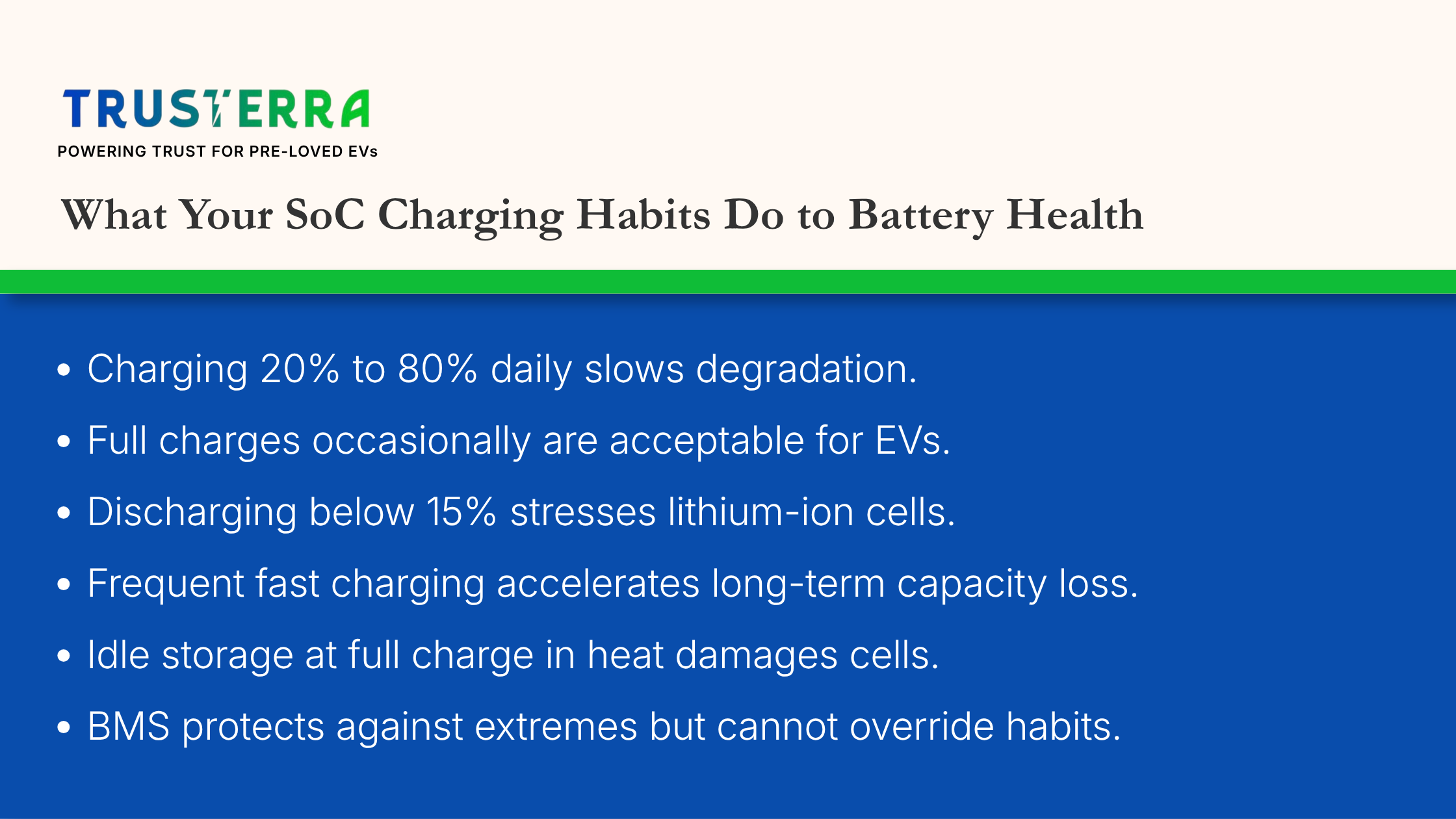
Charging habits linked to State of Charge levels directly influence how quickly battery capacity degrades. Keeping SoC between 20% and 80% during daily use puts less stress on lithium-ion cells than routinely charging to 100% and discharging to near zero. This is a high-priority action item an EV owner can undertake to protect resale value.
- Charging to 80% daily: Reduces cell stress and slows long-term capacity loss over years.
- Routinely charging to 100%: Acceptable occasionally but causes faster degradation in hot climates.
- Discharging below 15% regularly: Puts strain on lithium-ion cells and accelerates ageing.
- Fast charging frequently: Useful for emergencies, but repeated use reduces battery life faster.
What does SoC history reveal about a used EV before buying?
SoC history is a useful diagnostic for a used EV because it reveals how the previous owner treated the battery. A scooter whose data shows repeated deep discharges to near zero, or weeks stored at 100% State of Charge in summer heat, likely has greater degradation than its visible condition suggests.
Some EV brands in India provide app-based ride and charge history. Asking for this data before purchase is reasonable. It does not replace a professional battery inspection, but it gives context about usage patterns that kilometres alone cannot reveal.
A two-year-old scooter with 6,000 km on the odometer sounds like low mileage. If that scooter sat unused for 8 months at full charge in a Chennai parking lot, the SoH may reflect more stress than that of a scooter with 14,000 km and consistent daily use. Kilometres without SoC context is an incomplete picture.
Can you trust the SoC reading on a used EV display?
The SoC reading on a used EV display is generally reliable for its stated purpose: showing how much charge is currently available relative to the battery's capacity. It is not a measure of battery health, and it does not tell you how far the scooter will go on a full charge.
Where State of Charge can mislead used EV buyers is when sellers present a full or near-full battery as evidence of good condition. Charging a scooter to 95% before a viewing is straightforward. It tells the buyer nothing about the battery's true capacity or remaining useful life.
The more meaningful number to ask for is SoH. Combined, SoC and SoH give you a complete picture: how full the battery is today and how much total energy it can hold.
How does Trusterra factor in State of Charge and charging patterns during EV assessment?
Trusterra's inspection process goes beyond a single SoC reading at the time of visit. The AI-backed assessment includes charging behaviour, usage patterns and battery data as part of its more than 200-point evaluation. This gives a much clearer picture of how the battery has been treated over its lifetime.
The TrueV™ Score that Trusterra assigns to a vehicle accounts for battery health, range, and remaining useful life. SoC history, where available, provides context about whether a battery has been treated carefully or pushed toward extremes throughout its use.
For sellers, this means Trusterra's valuation reflects what the battery genuinely offers, not what a freshly charged display shows. For buyers and dealers, it provides a basis for confident pricing rather than guesswork.
Use Trusterra to get a battery-honest valuation for your used EV. Book a doorstep inspection and know the real story behind the battery percentage.