


Battery Management System (BMS): What It Does in Your EV
A Battery Management System (BMS) protects and monitors an EV battery. Learn what BMS does, why it matters for used EV buying, and what a failing BMS means for resale.
What is a Battery Management System and what does it do in an EV?
A Battery Management System, or BMS, is a type of an electronic control unit that monitors and manages every cell in an EV battery pack. It tracks voltage, temperature, current flow and charge levels continuously. The BMS uses this data to keep the battery operating safely within the manufacturer's defined limits.
The BMS does not store energy or generate power. It is a supervisory system that determines when to allow charging, when to limit power output, and when to disconnect the battery in response to a fault. Without a BMS, a lithium-ion battery pack would be dangerous to use at scale.
In an electric scooter, the Battery Management System is typically a compact circuit board built into or near the battery pack. It communicates with the charger, the motor controller and any connected app to share real-time battery status. Its condition and software version matter significantly for long-term battery life.
What specific functions does a Battery Management System perform in an electric vehicle?
A Battery Management System performs several functions that work together to protect the battery and extend its usable life. These functions run in the background during every ride, every charge and every period of idle storage. Understanding them helps explain why BMS quality varies across EV brands and why it matters for used EV buyers.
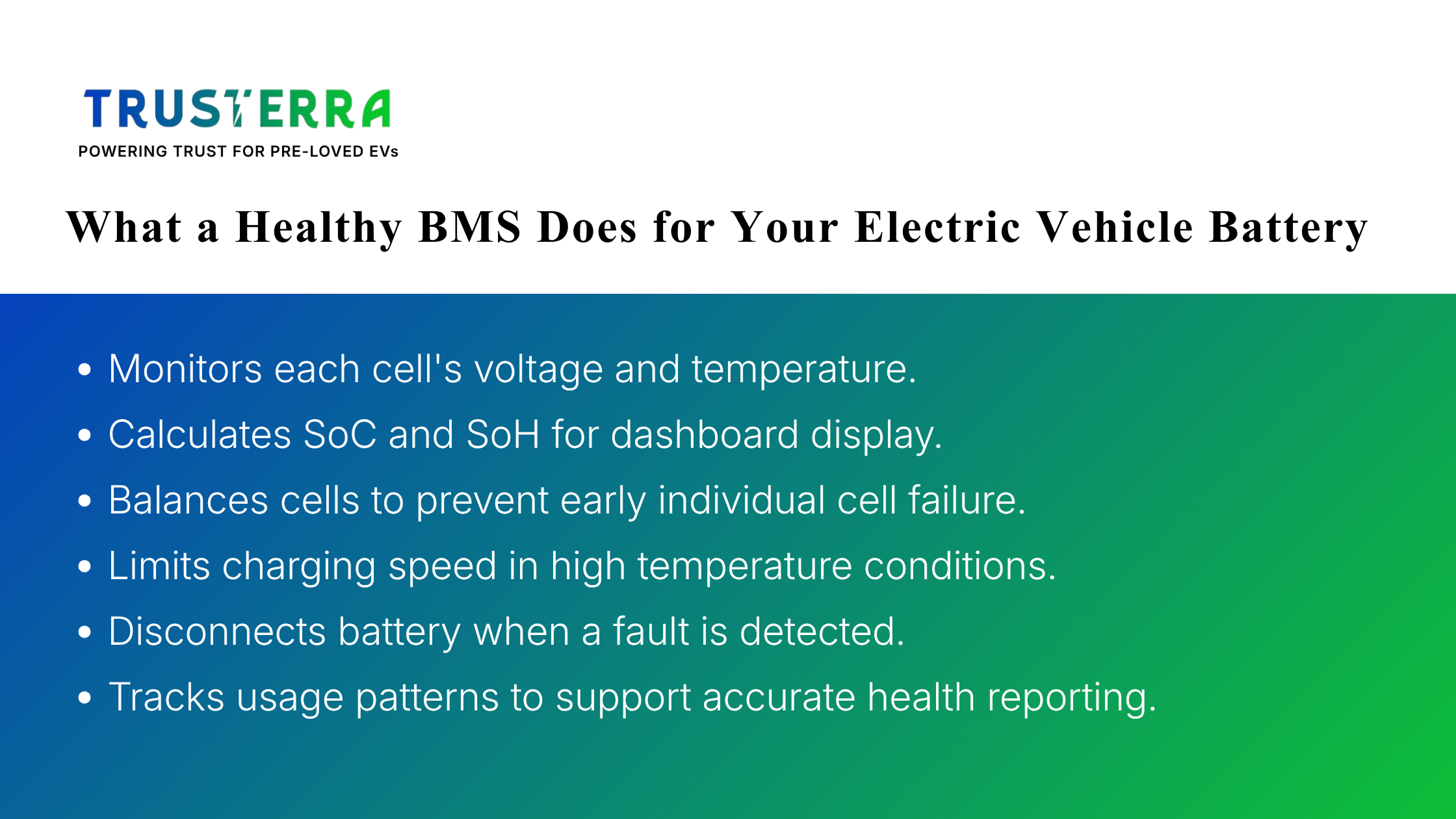
- Cell monitoring: Measures the voltage and temperature of individual cells within the pack to detect imbalances before they cause damage.
- State of Charge calculation: Tracks energy going in and out of the battery to estimate the current charge level shown on the dashboard display.
- State of Health tracking: Accumulates data over cycles to estimate how much of the battery's original capacity remains available for use.
- Cell balancing: Redistributes charge across cells to ensure they age at a similar rate, preventing individual cells from failing ahead of the pack.
- Thermal management: Monitors battery temperature and limits charging speed in both high and low temperature conditions, or signals the cooling system, to keep the pack within safe operating limits.
- Overcharge and discharge protection: Prevents the battery from being charged beyond its safe maximum or discharged below its safe minimum voltage threshold.
Why does BMS quality matter more in India's climate and road conditions?
India's climate and road conditions place specific demands on a Battery Management System. High ambient temperatures in cities like Ahmedabad, Chennai and Nagpur push battery cells toward thermal stress for months at a time. A well-functioning BMS responds by limiting charging speed, adjusting power output and triggering thermal protection. A malfunctioning BMS, one that isn't reporting or managing the battery correctly, does not react in time.
Road conditions add a further layer of stress. Rough surfaces, frequent stops and uneven terrain create variable load patterns that affect battery discharge rates. The BMS must handle these fluctuations across the full working day of a delivery rider in Mumbai or a commuter in Bengaluru.
What are the signs that a used EV has a BMS problem?
Battery problems in a used EV do not always produce obvious faults. Some signs appear gradually and are easy to attribute to general wear and tear. Knowing the difference helps buyers identify scooters with deeper issues before committing to a purchase.
A sudden and unexplained drop in range is one of the most common early signals. If a scooter rated for 80 km per charge now delivers 50 km without a gradual decline over months, the battery may be degrading faster than expected, or the BMS may not be reporting the charge level correctly.
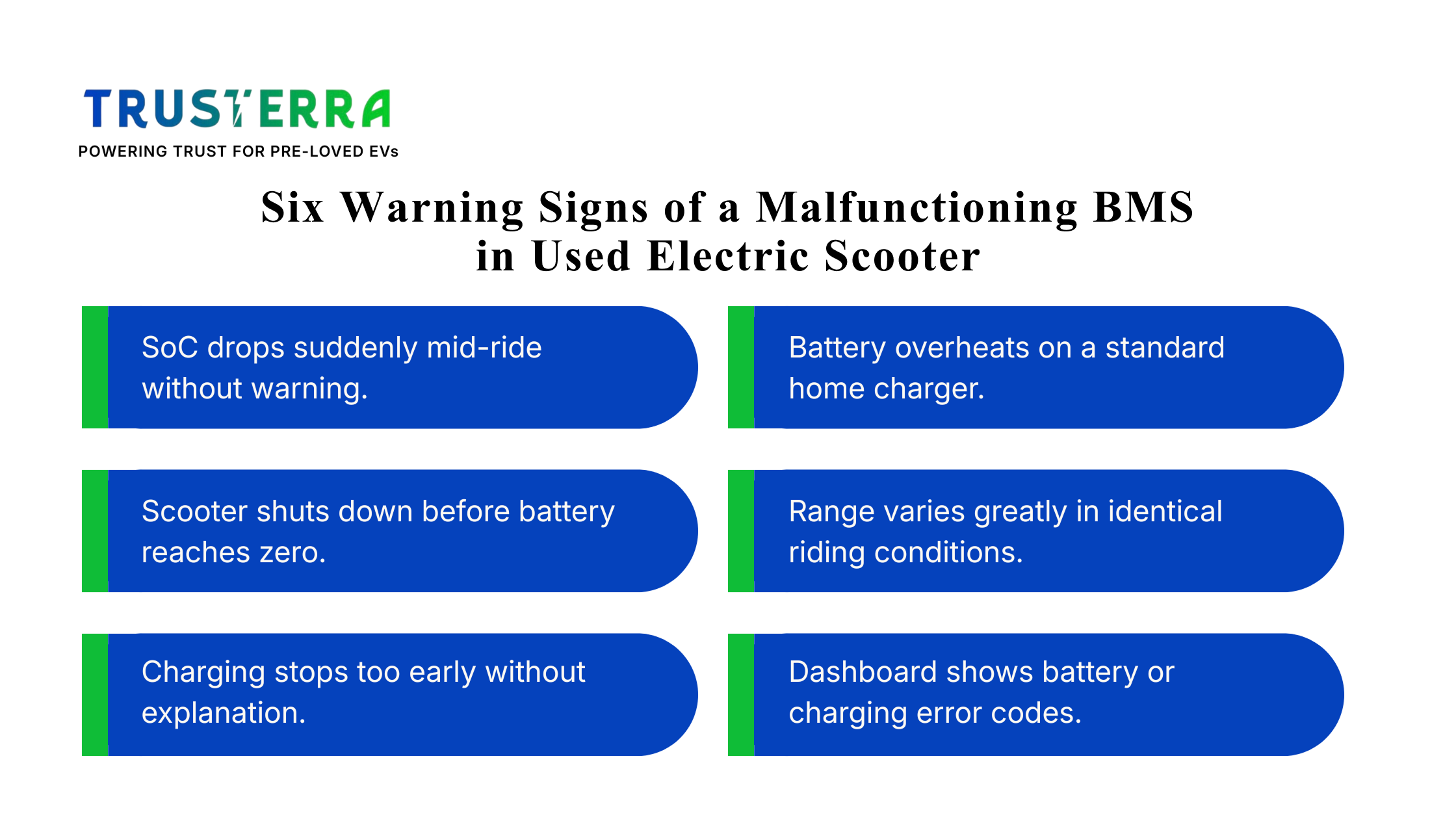
Here are the red flags that may indicate battery issues in a used EV:
- The SoC reading drops sharply from, say, 60% to 20% within a short ride.
- The scooter shuts down unexpectedly before the battery reaches 0%.
- Charging stops earlier than expected without reaching the target percentage.
- The battery gets unusually hot during a normal home charge session.
- Range varies widely between days with identical riding conditions and routes.
- Error codes appear on the dashboard related to battery or charging faults.
How does Battery Management System condition affect the resale value of a used EV in India?
A healthy BMS directly supports a higher resale value because it indicates the battery has been well-protected throughout its use. A BMS that has functioned correctly keeps cells balanced, prevents overcharge, and manages heat. The result is a battery that retains a higher SoH and delivers a more reliable range.
A faulty or outdated Battery Management System may have allowed the battery to operate outside safe parameters without the previous owner's knowledge. The battery may appear functional but carry hidden degradation that only becomes apparent under independent testing.
For dealers and fleet operators reselling large volumes of used EVs, Battery Management System condition is a commercial consideration. A batch of scooters with a malfunctioning BMS that isn't reporting or managing the battery correctly, even from a reputable brand, can create customer complaints and warranty issues after resale. Verifying BMS software version and diagnostic history should be part of any fleet assessment process.
Expert View: BMS software matters as much as BMS hardware in a used EV. Manufacturers release BMS firmware updates that improve cell balancing, thermal management and SoH accuracy. Any EV running an outdated firmware version may report battery health incorrectly. Checking whether the BMS has received available updates is a worthwhile step before any resale transaction. |
Can a Battery Management System be repaired or updated after purchase in India?
BMS software can often be updated by authorised service centres for EV brands that have released firmware improvements. This is different from repairing a physically damaged BMS, which requires component-level work and is not a standard consumer-facing service. Firmware updates are more accessible and can improve the accuracy with which the BMS calculates SoC and SoH.
Physical damage to the Battery Management System, caused by water ingress, impact, or severe overheating, typically requires replacement. BMS replacement costs vary by model and brand, ranging from a few thousand rupees for two-wheeler units to significantly more for larger battery packs. Always factor this possibility into the price negotiation on a used EV with suspected BMS issues.
For EV owners considering resale, getting the BMS software updated by an authorised centre before listing the vehicle is a worthwhile step. An updated BMS that reports accurate battery health gives buyers more confidence and supports a stronger asking price.
How does Trusterra use BMS data in its used EV assessment process?
Trusterra's inspection process accesses battery diagnostics that go beyond what a standard visual check can reveal. BMS data, including SoC history, charge cycle count, thermal records and fault logs, feeds into the AI-backed valuation model. This gives a more complete picture of how the battery has been managed over its lifetime.
The TruEV™ Score that Trusterra assigns to a used EV incorporates battery health signals drawn from BMS diagnostics. A scooter with a well-functioning BMS, clean thermal history and consistent charging behaviour will reflect this in its score. A vehicle with Battery Management System anomalies or irregular data will be assessed accordingly.
This matters particularly for dealers and fleet operators who are evaluating multiple vehicles at once. Rather than relying on visual inspection and seller claims, Trusterra provides a data-backed assessment that reduces the risk of buying a used EV with hidden battery or BMS issues.
Get your used EV assessed by Trusterra. Book a doorstep inspection and receive a transparent battery and BMS report before you sell or buy.