


Remaining Useful Life (RUL) Explained for EV Owners
Remaining Useful Life tells you how much more your EV battery can deliver. Learn how RUL works and why it matters for used EVs.
What Is Remaining Useful Life (RUL) of an EV Battery?
Remaining Useful Life, or RUL, is an estimate of how much longer an EV battery can deliver useful performance before reaching its end of life. It is expressed in time, kilometres, or charge cycles, depending on the prediction model used.
- Forward-Looking Battery Metric: Unlike SoH, which tells you the battery's current health, RUL predicts how long that health will last. SoH says the battery is at 85 percent today. RUL says the battery will reach end of life in roughly six more years of similar use.
- Measured in Multiple Units: RUL can be expressed as remaining years, kilometres, or full charge cycles. Each unit serves a different audience. Buyers prefer years. Lenders prefer cycles or kilometres. The unit chosen depends on the use case and decision being made.
- Depends on Usage Pattern Forecast: RUL is not a fixed number. It assumes the owner will continue using the EV the same way. If charging habits change, climate shifts, or daily mileage grows, the actual remaining life may differ from the early estimate.
- End of Life Defined by Threshold: End of life usually means the battery has dropped to 70 or 80 percent of original capacity. At this point, range loss begins to affect daily use. RUL counts the time, distance, or cycles until that threshold is reached.
Key Takeaways:
|
How is RUL different from State of Health (SoH)?
SoH and RUL work together but answer different questions. SoH reports the battery's present condition. RUL projects how long that condition will last. Buyers and sellers need both for a full picture during a used EV deal.
Aspect | State of Health (SoH) | Remaining Useful Life (RUL) |
What It Measures | Current battery capacity | Future battery lifespan |
Time Direction | Looks at the past and present | Looks ahead at the future |
Unit | Percentage of original capacity | Years, kilometres, or cycles |
Calculation Type | Direct measurement | Predictive estimation |
Use Case | Resale pricing today | Ownership planning ahead |
Accuracy | High, based on real data | Moderate, depends on model |
This split matters during used EV deals. A buyer should check both numbers. SoH tells the present truth. RUL guides the next decision. Together, they form the strongest backbone of any informed used EV purchase.
How do experts calculate Remaining Useful Life of an EV battery?
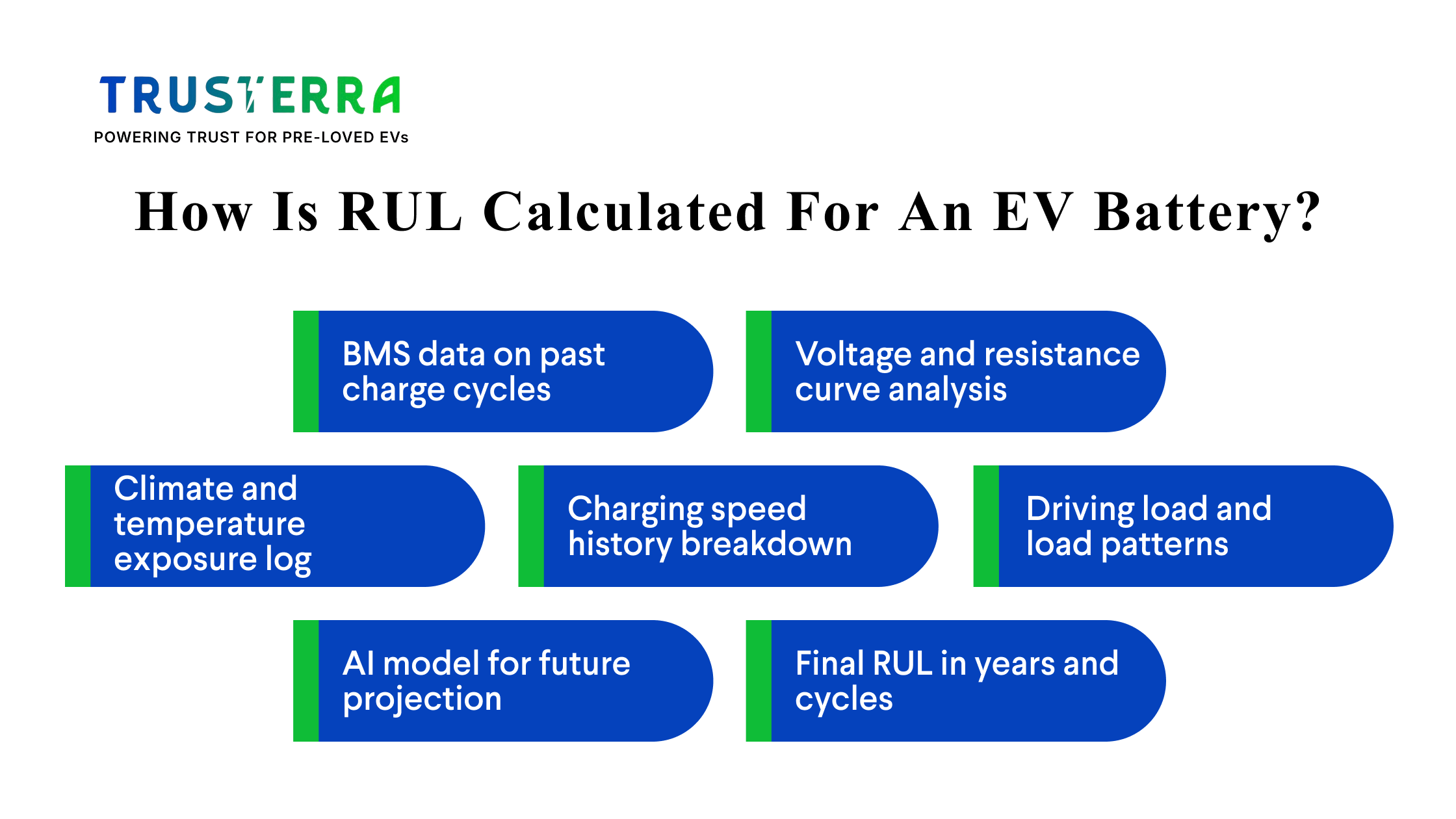
RUL calculation combines historical data with predictive modelling. The battery management system records charge cycles, voltage curves, temperature exposure, and capacity readings. Engineers feed this data into AI models that project how the pack will age under similar future use.
The most common models include data-driven machine learning, physics-based simulation, and hybrid approaches. AI methods use deep learning to spot patterns in degradation curves. Physics-based models work from chemistry equations. Hybrid models combine both for higher accuracy across real-world driving conditions.
For Indian-used EVs, accurate RUL estimation requires local data. A pack used in Chennai's heat ages differently from one driven in Shimla's cold. TrusTerra's models account for these climate-specific patterns, which helps reduce errors that generic global RUL tools often produce.
What factors affect the accuracy of an RUL estimate for an EV battery?
RUL accuracy depends on the quality of input data and the strength of the prediction model. Two cars of the same age can show different RUL numbers if one has been used and tracked far better than the other during ownership.
- Quality of historical data from the battery management system shapes the prediction more than any other single input variable.
- Climate exposure record tells the model how much heat or cold the battery has handled across its full life.
- Charging speed pattern reveals whether the pack has been stressed by daily DC charging or rested through slow AC charging.
- Driving load history shows whether the EV has been used for long highway runs or short city commutes mainly.
- AI model design decides how well the system spots subtle degradation patterns that simple linear projections often miss in practice.
Why does RUL matter for used EV buyers in India?
RUL turns a battery into a measurable asset for the buyer. It moves the conversation from vague claims to forward-looking numbers. For Indian buyers stepping into the used EV market, this clarity changes how decisions are made and priced.
- Plan Ownership With Confidence: Knowing the pack has six more years of useful life lets the buyer plan finances around it. The buyer can decide whether the EV fits a five-year ownership target or whether replacement cost will land before the plan ends.
- Negotiate Price Based on Future: RUL gives the buyer leverage during price talks. A high RUL supports the seller's higher asking price. A low RUL gives the buyer reason to ask for a fair discount that reflects the shorter remaining lifespan.
- Match Vehicle to Daily Use Need: A delivery rider needs high RUL to handle heavy daily mileage. A weekend driver can accept a lower RUL because daily wear is lighter. Matching RUL to use case prevents premature battery replacement costs.
- Access Better Loan Terms: Lenders use RUL to assess residual value. A used EV with strong RUL qualifies for better loan terms. This broadens the buyer pool, helps sellers close faster, and supports growth in the used EV finance market.
How do lenders use RUL while approving used EV loans?
Lenders treat used EVs differently from petrol cars because the battery carries most of the residual value. RUL becomes a key input in underwriting. A pack with strong remaining life supports lower loan risk and unlocks better interest rates for the buyer.
Indian NBFCs and banks have started building RUL-aware credit models for EV loans. The lender wants to know that the collateral will hold value across the loan tenure. A four-year EV loan needs a battery with at least four years of clear RUL.
Without RUL data, lenders price the loan conservatively. They assume the worst case and charge a higher interest rate. This makes used EV financing expensive. Verified RUL reports from platforms like TrusTerra help bring this rate down for both lenders and buyers.
Can owners extend the Remaining Useful Life of their EV?
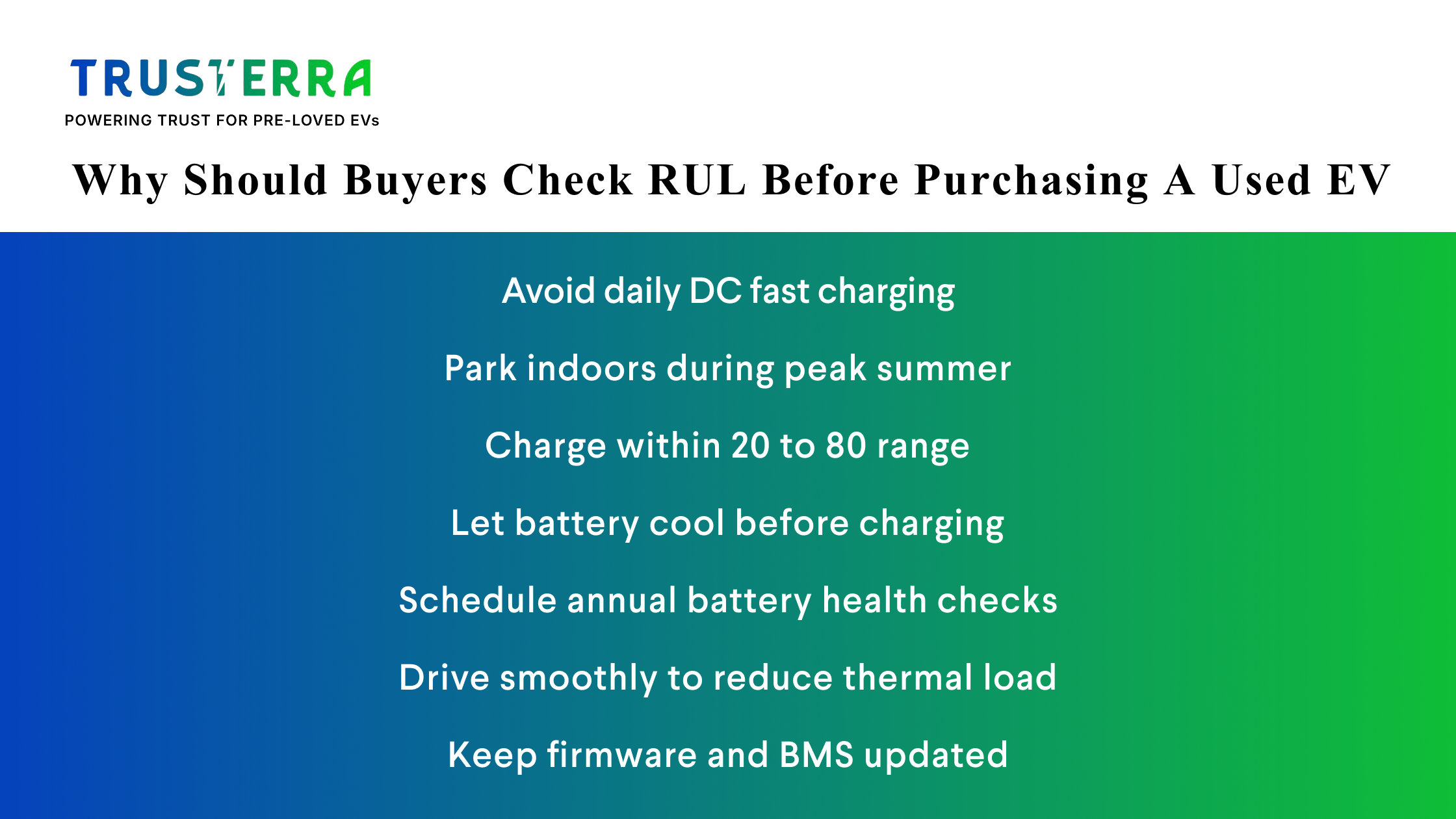
Yes, smart ownership habits can push RUL beyond initial projections. The same factors that slow degradation extend remaining life. Indian EV owners who follow these habits often see their actual RUL exceed early estimates by one or two extra years.
- Slow charging at home reduces heat stress, which extends the pack's chemical life and pushes RUL forward by months.
- Avoiding full charge storage keeps voltage stress low, helping the cathode last longer across the years of ownership.
- Parking in shade or covered spots during summer protects against calendar ageing, which adds time to projected RUL.
- Maintaining moderate driving habits lowers thermal load per kilometre and stretches both cycle count and total time remaining.
- Scheduling annual battery health checks catches small issues early before they shorten RUL through compounding degradation effects.
How does TrusTerra estimate and report RUL for used EVs?
TrusTerra estimates RUL through an AI-driven model trained on Indian EV usage data. The platform combines BMS readings, climate history, charging patterns, and driving load into the prediction engine. The output appears within the TruEV™ Score, shown in years and cycles.
This matters because most used EV deals in India lack any forward-looking battery data. Sellers rely on age. Buyers guess based on appearance. TrusTerra brings RUL into the conversation through a verified report that both parties can trust during the price negotiation.
For lenders and dealers, the same RUL report supports stronger underwriting and faster inventory turnover. A documented RUL means used EVs become finance-ready assets rather than uncertain liabilities. This shift is what the Indian used EV market needs to scale through the next decade.
Get a verified RUL projection for your EV through the TruEV ScoreTM today.