


Battery Pack vs Battery Cell
Understand battery pack vs battery cell differences, how cells form an EV pack, and what used EV buyers should inspect.
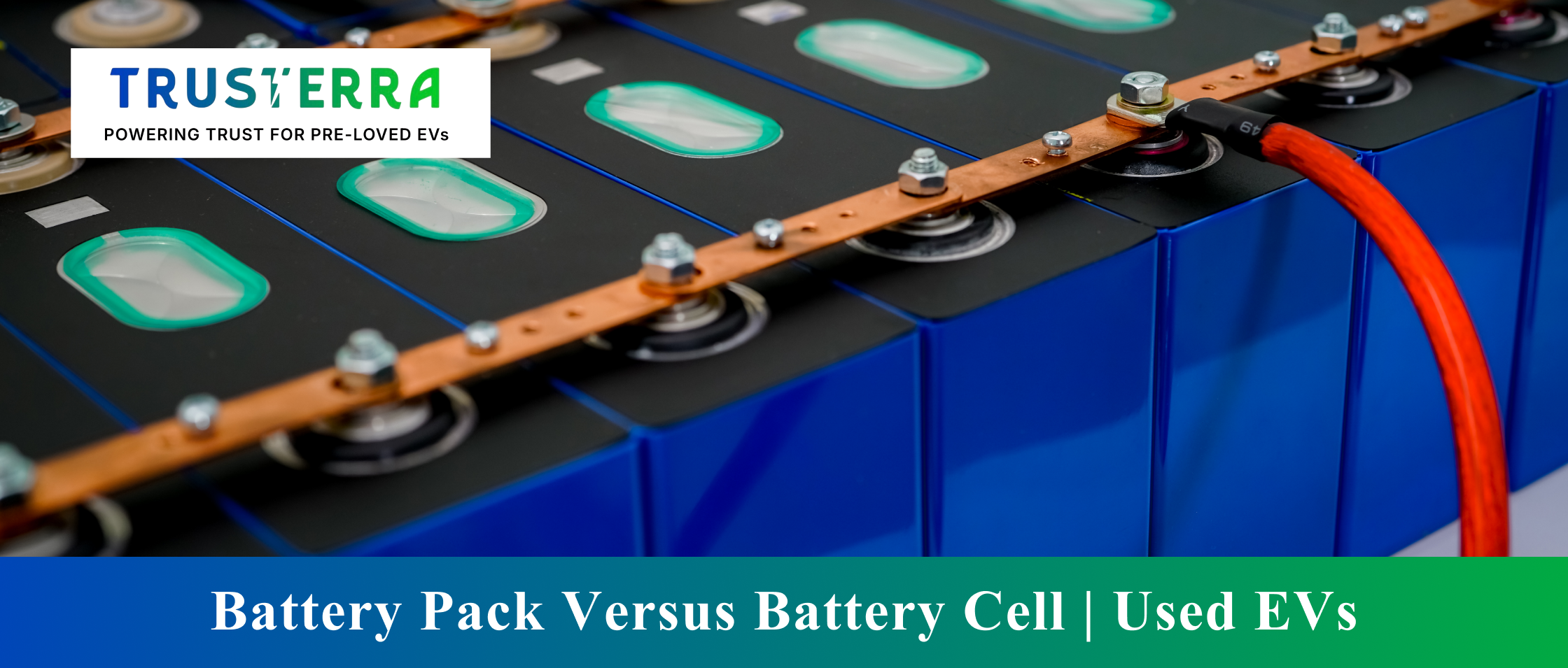
What Is the Difference Between a Battery Pack and Battery Cell?
An electric vehicle does not run on one single battery cell. It uses many cells connected in series and parallel combination within a protected battery pack. These two terms describe different parts of the same energy system, yet used EV listings often use them as though they mean the same thing.
The distinction matters during battery inspection. A healthy pack depends on cell condition, electrical connections, cooling, software, and structural protection. A problem at one level can affect the entire vehicle, even when most battery components continue to work as expected.
This glossary explains the difference between a battery pack and a battery cell in simple terms. It covers how cells become modules or packs, why one weak section matters, and what buyers should inspect. EV packs commonly contain modules made from several cells, although newer designs can place cells directly into packs.
Key Takeaways:
|
What is an EV battery cell?
A battery cell is the smallest independent unit that stores electrical energy inside an EV battery. Each cell contains electrodes, an electrolyte, a separator, and an outer enclosure. Cells produce a limited voltage, so manufacturers connect many units to meet vehicle energy and power needs.
- Energy-storing unit: A cell converts stored chemical energy into electrical energy when the EV draws power. It accepts electrical energy again when the vehicle charges or captures energy through regenerative braking.
- Cell chemistry: The electrode materials define the cell chemistry, such as LFP or NMC. Chemistry affects voltage, energy density, heat tolerance, charging behaviour, and ageing characteristics.
- Physical cell format: EV manufacturers use cylindrical, pouch, or prismatic cells. Each format creates different packaging, cooling, manufacturing, and repair considerations inside the complete battery pack.
- Individual variation: Cells produced together can still develop small differences over time. Temperature exposure, current demand, and manufacturing variation can make one cell age faster than neighbouring cells.
- Cell voltage: Cell Voltage is the measure of electrical pressure that a single battery cell can provide to move electricity through a circuit.
What is an EV battery pack?
An EV battery pack is the complete high-voltage energy storage system installed in the vehicle. It contains battery cells plus electrical connections, monitoring systems, thermal controls, structural protection, and safety components. The pack stores energy and supplies controlled power to the traction motor.
- Cell assembly: The pack contains many connected cells arranged to deliver the required voltage and capacity. Some designs place cells within modules, while cell-to-pack designs remove the separate module layer.
- Battery management system: The BMS monitors cell voltage, temperature, current, and charge level. It limits performance when any section approaches an unsafe operating condition.
- Thermal management: Cooling and heating systems keep cells within a suitable temperature range. Good thermal control supports performance, charging speed, safety, and battery life in demanding Indian conditions.
- Structural enclosure: The pack casing protects battery components from impact, water, dust, vibration, and road debris. Damage to this enclosure can create risk even when cells still hold charge.
- High-voltage controls: Contactors, fuses, sensors, and service disconnects manage power flow. These parts protect the vehicle and technicians during normal use, faults, maintenance, or collision response.
How is a battery pack different from a battery cell?
A battery cell stores a small amount of electrical energy through an electrochemical reaction. A battery pack combines many cells with cooling, control, wiring, and safety systems. The cell generates energy, while the pack manages it for safe vehicle operation.
| Difference | Battery cell | Battery pack |
| Basic role | Stores energy through an individual electrochemical unit | Supplies manage energy to the complete electric vehicle |
| Physical scale | Smallest independent energy-storing part of the battery | Complete assembly installed beneath or within the vehicle |
| Main components | Contains electrodes, electrolyte, separator, and outer casing | Contains cells, controls, cooling, wiring, and protection |
| Electrical output | Produces limited voltage and energy on its own | Combines cells for required vehicle voltage and capacity |
| Health concern | Can develop resistance, imbalance, leakage, or capacity loss | Can suffer cooling, connection, control, or enclosure problems |
| Repair decision | Depends on the cell parameters of capacity and resistance | Depends on the number of cells to be replaced in a module and/or number of modules to be replaced in a pack |
| Used EV value | Reveals localised weakness within one battery section | Determines overall range, power, safety, and replacement risk |
These differences explain why “battery health” is not one simple measurement. Cell readings show what happens inside individual groups. Pack checks reveal whether cooling, controls, electrical pathways, and physical protection still work together.
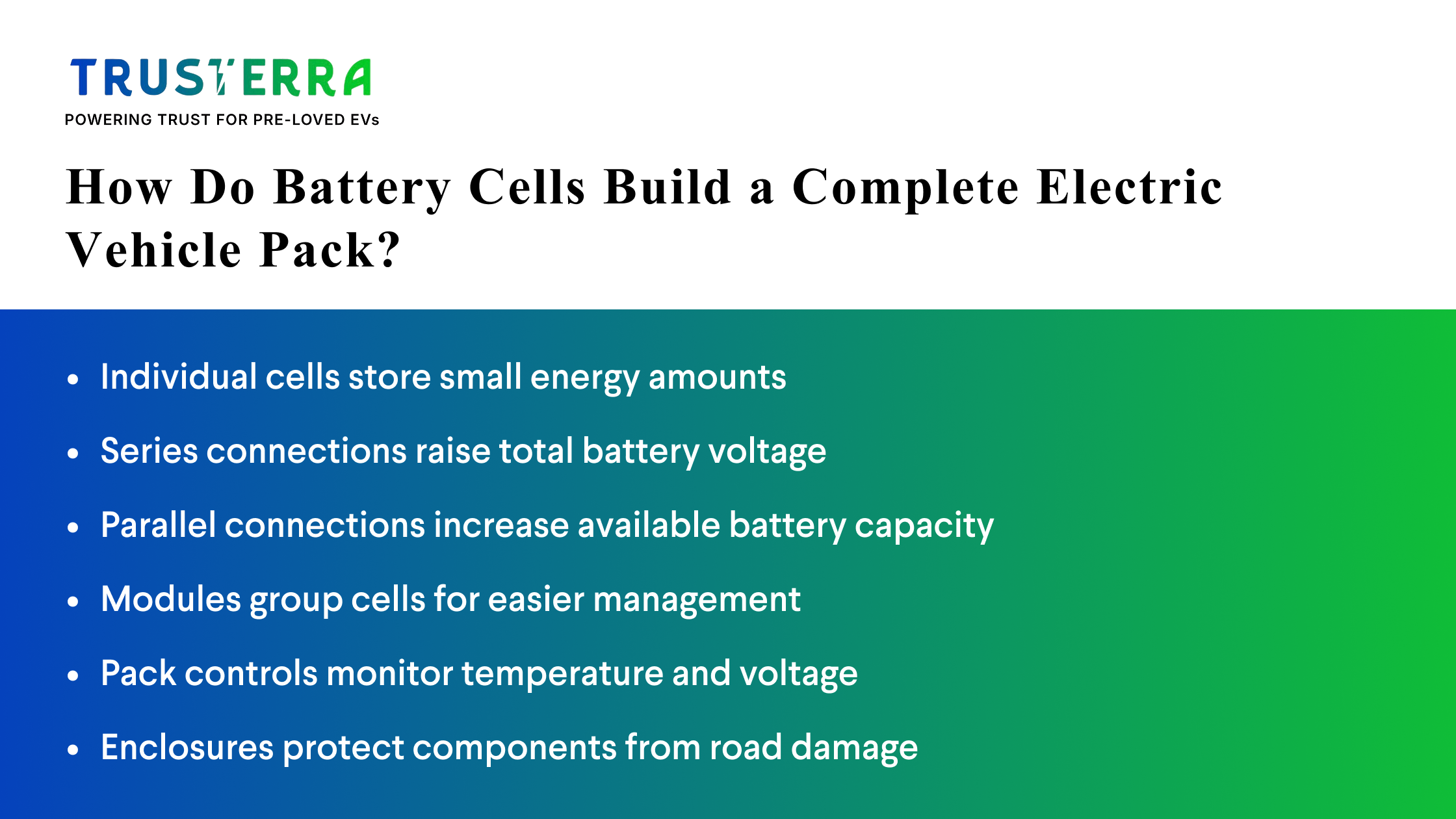
How do cells, modules, and packs work together?
Cells provide the basic energy storage. Modules organise groups of cells into manageable sections, while the pack connects those sections with controls and protection. Some newer EVs remove modules and place cells directly inside the pack, which changes space use and repair options.
- Series cell connections: Cells connected in series increase total voltage. If one series-connected cell reaches its safe limit first, the BMS may restrict the complete string to protect that cell.
- Parallel cell connections: Cells connected in parallel increase current capability and capacity. Current may divide unevenly when one cell develops different resistance or temperature behaviour from neighbouring cells.
- Module organisation: Modules group cells within separate frames and electrical sections. This layout can simplify manufacturing, monitoring, cooling, and selected repairs, depending on the manufacturer’s service design.
- Pack integration: The complete pack joins modules or direct cell groups with the BMS, cooling system, contactors, wiring, and structural casing. Pack integration shapes vehicle range and performance.
- Cell-to-pack design: Some manufacturers remove the module stage to improve space use and energy density. This approach can reduce inactive material, but repair methods depend on the specific pack construction.
Why can a single weak cell affect the entire battery pack?
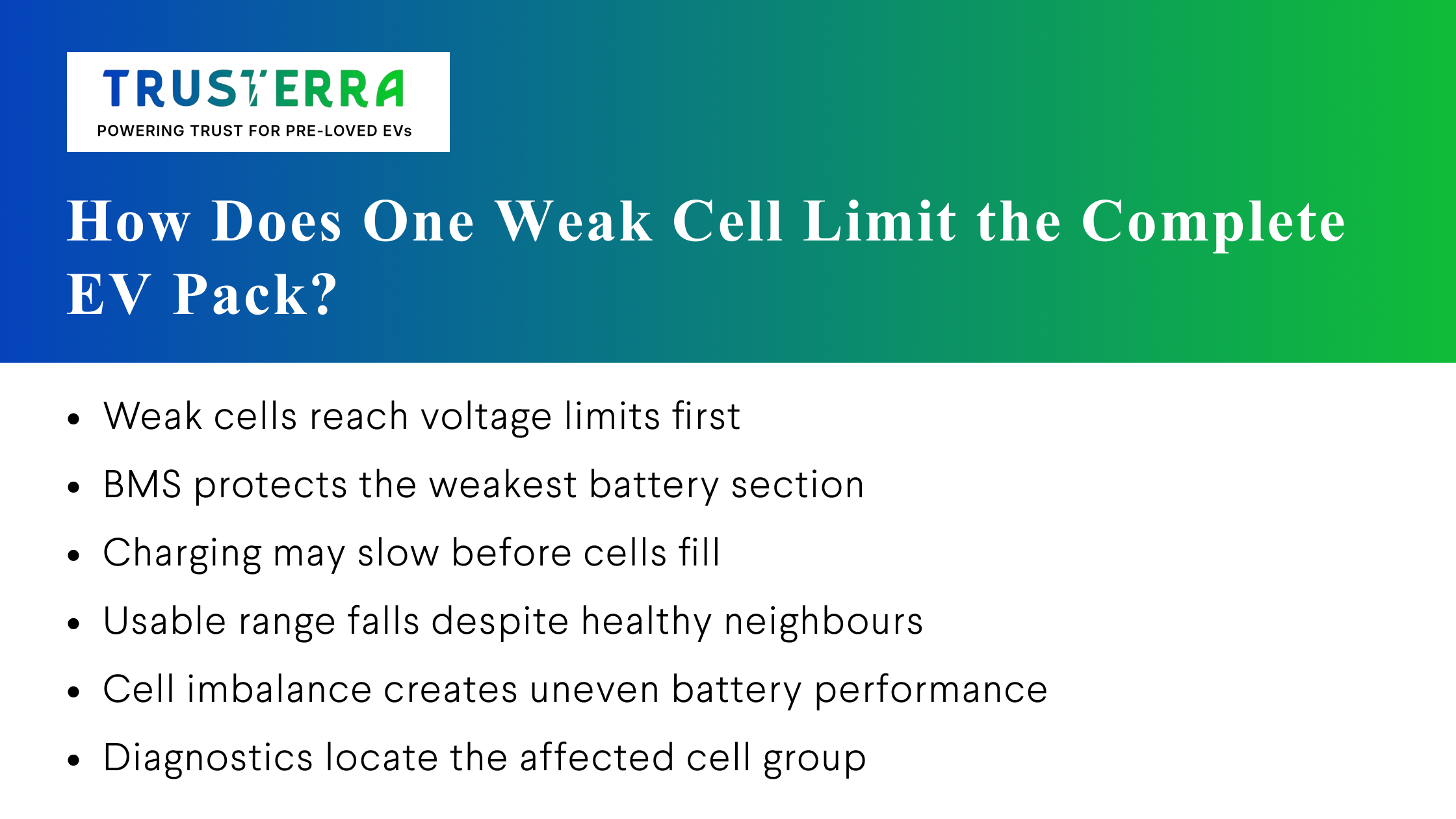
One weak cell can affect the full pack because connected cells must operate within shared safety limits. The Battery Management System protects the weakest section first. It may reduce usable capacity, charging power, or motor output before healthy cells reach their own limits.
During discharge, a weak cell can reach its lower voltage limit earlier. The BMS may stop further discharge to prevent damage. The driver loses access to energy still stored in stronger cells, reducing the pack’s practical range.
During charging, the same cell may reach its upper voltage limit first. Charging must slow or stop while other cells remain below full charge. This creates imbalance and can make range estimates less consistent across repeated charging sessions.
Cell balancing may correct small differences, but it cannot repair serious ageing or physical damage. Buyers should review the cell balancing glossary alongside evidence of cell voltage spread, temperature variation, and internal resistance. Poor cell integration can undermine otherwise capable cells.
Can a damaged cell be replaced without replacing the pack?
A damaged cell can sometimes be replaced without changing the complete pack, but repairability depends on battery design. Many manufacturers authorise module replacement rather than individual cell work. Sealed cell-to-pack systems may offer fewer repair options outside specialised facilities.
- Manufacturer repair policy: Authorised service centres follow brand-specific procedures. Some replace modules, while others replace the complete pack because cell-level work needs controlled tools, training, and safety processes.
- Pack construction: Bolted modules may allow easier access than bonded or structural packs. Adhesives, cooling plates, wiring design, and enclosure sealing can complicate repair.
- Cell matching: A replacement cell must match chemistry, capacity, resistance, voltage behaviour, and ageing level. A new cell placed beside older cells can create further imbalance.
- Safety validation: Repaired packs need insulation testing, leak checks, BMS verification, and controlled charge testing. Closing the enclosure without these checks can create safety or reliability risks.
- Warranty position: Unauthorised opening of the pack can affect manufacturer warranty coverage. Buyers should confirm where the repair work was carried out and whether the manufacturer recognises the completed repair.
What should buyers inspect at cell and pack level?
Used EV buyers should inspect both cell-level consistency and complete pack condition. Cell data reveals localised weakness, while pack checks cover cooling, electrical controls, physical protection, and software records. Reviewing one level without the other can leave important battery risks hidden.
- Check cell voltage spread because one weaker group can restrict usable range and charging performance.
- Review temperature variation because uneven heat may reveal cooling faults or stressed battery sections.
- Compare cell resistance readings, as higher resistance can indicate weak groups before major capacity loss occurs.
- Inspect the pack enclosure for impact marks, corrosion, water entry, or repairs around sealed joints.
- Review the BMS fault history because cleared dashboard warnings may still appear in diagnostic records.
A good report should connect these checks with SoH, range evidence, and charging behaviour. Buyers should then compare the result with the warranty status and expected access to repairs. This supports a price based on current condition rather than brochure capacity.
Pack structure also affects valuation. A serviceable modular pack may offer clearer repair routes than a sealed structural design. However, repairability still depends on the availability of local parts, authorised support, and the nature of the damage.
How do we inspect battery cells and packs at TrusTerra?
We assess the battery as a connected system rather than treating pack health as one percentage. TerraScan supports access to cell-group voltage, temperature behaviour, BMS history, and wider pack signals where vehicle data allows. Physical inspection adds context around enclosure and connection conditions.
The TruEV Score™ connects cell consistency to usable range and remaining-battery confidence. It helps explain whether a weak section affects the wider pack. This gives buyers clearer evidence than age, kilometres, or dashboard range alone.
We help buyers, sellers, dealers, and lenders use the same battery evidence during valuation. Our wider marketplace also uses battery health within its pricing approach, reflecting the importance of pack condition in pre-owned EV transactions.
Book a TerraScan inspection to assess both cell-level health and the overall pack condition before a used EV transaction.