


What Is an NMC Battery in Electric Vehicles?
NMC batteries deliver high range and fast charging for premium EVs. Learn how they work and what they mean for used EV buyers in India.
What Is an NMC Battery in Electric Vehicles?
NMC stands for nickel manganese cobalt, the three metals used in the cathode of each battery cell. This combination delivers high energy density, which means the battery stores more energy relative to its size and weight. As a result, NMC batteries can power a smaller, lighter pack while still delivering a strong range, making them a common choice for premium EVs.
- Nickel for High Energy Density: Nickel is the main contributor to energy storage in NMC cells. Higher nickel content means more usable capacity per kilogram. Modern NMC variants like NMC 811 use 80 per cent nickel to push range numbers higher in luxury EV models.
- Manganese for Cell Stability: Manganese adds structural stability to the cathode and keeps the chemistry safer under stress. It helps the battery handle higher charging rates without breaking down. Without manganese, high-nickel cells would lose stability and pose a greater safety risk.
- Cobalt for Chemistry Balance: Cobalt holds the cathode structure during repeated charging and discharging. It improves cycle life and reduces capacity loss. Cobalt is costly and ethically tricky to source, which is why newer NMC blends try to reduce its share.
- Graphite Anode for Ion Storage: Like LFP packs, NMC batteries use a graphite anode. The anode stores lithium ions during charging and releases them while driving. Some advanced NMC packs now use silicon-mixed anodes to push energy density even higher per cell.
Key Takeaways:
|
How is an NMC battery different from an LFP battery?
NMC and LFP batteries serve different priorities. NMC delivers a higher range and faster charging, while LFP focuses on safety and lifespan. The choice between them shapes EV performance, cost, weight, and resale value over years of ownership.
| Feature | NMC Battery | LFP Battery |
| Energy Density | High (200 to 280 Wh/kg) | Moderate (90 to 160 Wh/kg) |
| Cycle Life | 1,500 to 2,500 cycles | 3,000 to 4,000 cycles |
| Heat Tolerance | Lower, more sensitive | Higher, very stable |
| Safety Profile | Good, but lower than LFP | Best in the category |
| Cost per kWh | Higher (cobalt-driven) | Lower |
| Common Use Case | Premium long-range EVs | Mass-market EVs |
This analysis makes the trade-off clear. A buyer choosing range and power should accept a higher cost and shorter cycle life. A buyer choosing daily reliability and resale strength should lean towards LFP-equipped EVs instead.
What are the key strengths of NMC batteries for EVs?
NMC batteries earn their place in premium EVs through clear performance strengths. The high energy density, charging speed, and power delivery make them suitable for long-range and high-performance vehicles across global markets.
- High energy density delivers more driving range per kilogram of battery weight, which suits long-range premium models.
- Faster DC charging allows ten to eighty per cent top-ups within thirty minutes at high-power public stations.
- Stronger power output supports quick acceleration in performance EVs, since cells can release energy at higher rates.
- Better cold-weather performance keeps range loss smaller than LFP packs during sub-ten-degree mornings in the northern regions of India.
- Compact pack size allows car designers to build sleeker cabins and lighter chassis without losing usable space.
What are the weaknesses of NMC batteries that Indian buyers should consider?
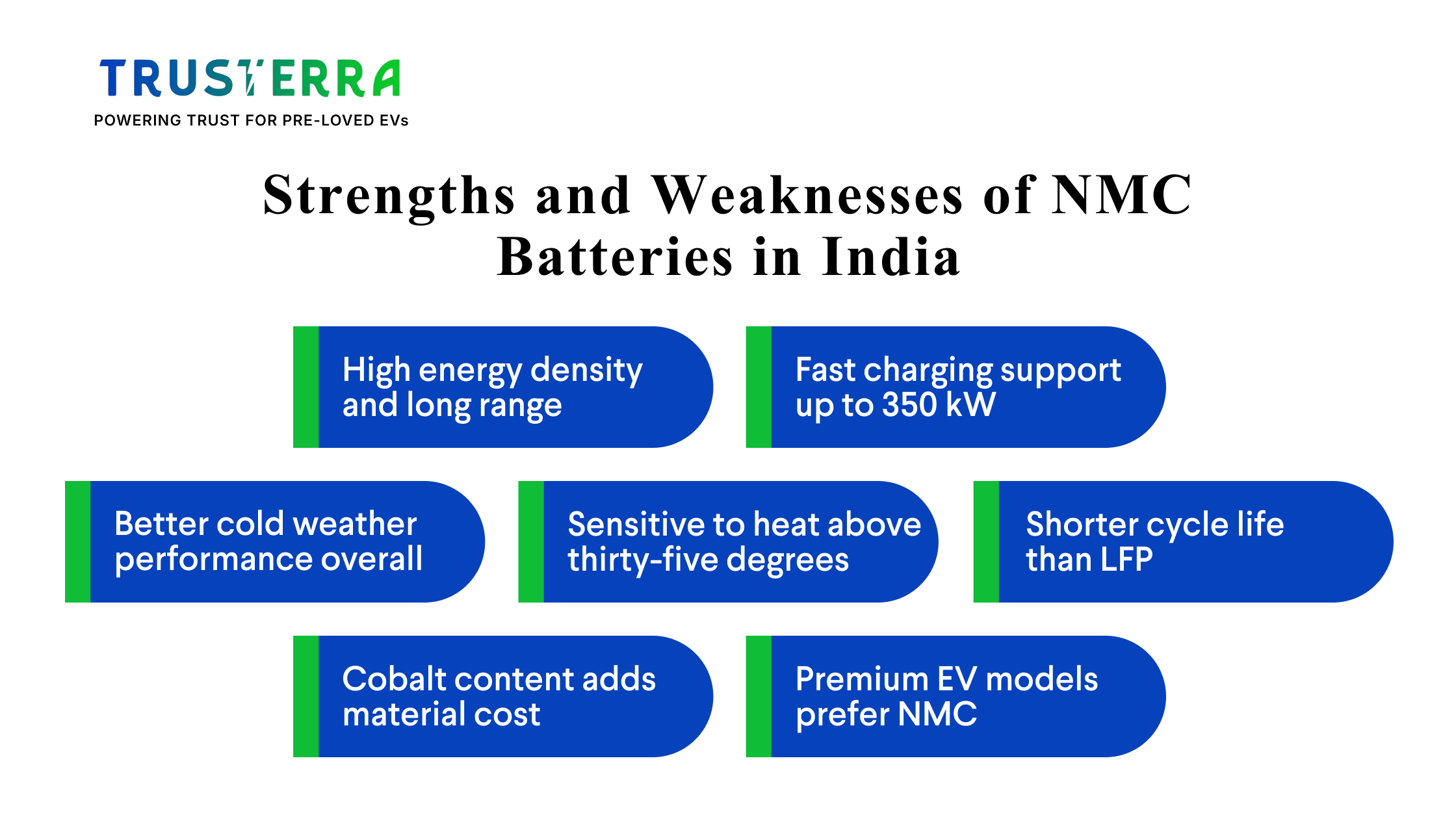
NMC batteries have drawbacks that matter to Indian buyers. Heat sensitivity is the biggest. NMC cells degrade faster in temperatures above 35°C, which describes most Indian cities for half the year. Active cooling helps, but the issue cannot be removed.
Cycle life is shorter than LFP. A typical NMC pack handles around 1,500 to 2,500 full cycles before reaching 80 percent SoH. For high-mileage users like ride-share drivers, this can mean a noticeable loss of range within five to seven years.
Cobalt cost and supply chain risk also affect long-term replacement pricing. Cobalt sourcing has ethical and geopolitical concerns. Indian buyers planning to keep an NMC EV past its warranty should factor in a higher potential replacement cost than for LFP-equipped models.
Which Indian EVs are powered by NMC batteries?
Several EVs in the Indian market use NMC chemistry, especially in the premium and long-range segments. Buyers looking for high range, fast acceleration, or feature-rich models will mostly encounter NMC packs. Older Tata and Mahindra EVs also used NMC before the LFP shift.
- Hyundai Kona Electric and Ioniq 5: Hyundai's EV range uses NMC packs across both Kona Electric and Ioniq 5. These models target long-range city and highway use. The NMC chemistry supports the high range claims that draw premium buyers in metros like Mumbai or Delhi.
- Kia EV6 and EV9: Kia's premium EV models in India use NMC chemistry for high range and fast charging. Both vehicles support the 800V charging architecture, which gives them an edge in highway driving where ultra-fast charging infrastructure is available.
- Older Tata Nexon EV (Pre-2023): Earlier versions of the Tata Nexon EV used NMC cells before Tata shifted to LFP for newer trims. Used Nexon EV buyers should check the manufacturing year and battery chemistry before deciding, since this affects long-term resale strongly.
- MG ZS EV and Older MG Models: The MG ZS EV uses NMC chemistry across most variants sold in India. Its 50.3 kWh pack delivers around 460 kilometres of claimed range. The chemistry choice supports highway driving but demands careful summer charging habits.
How should NMC EV owners care for the battery in India?
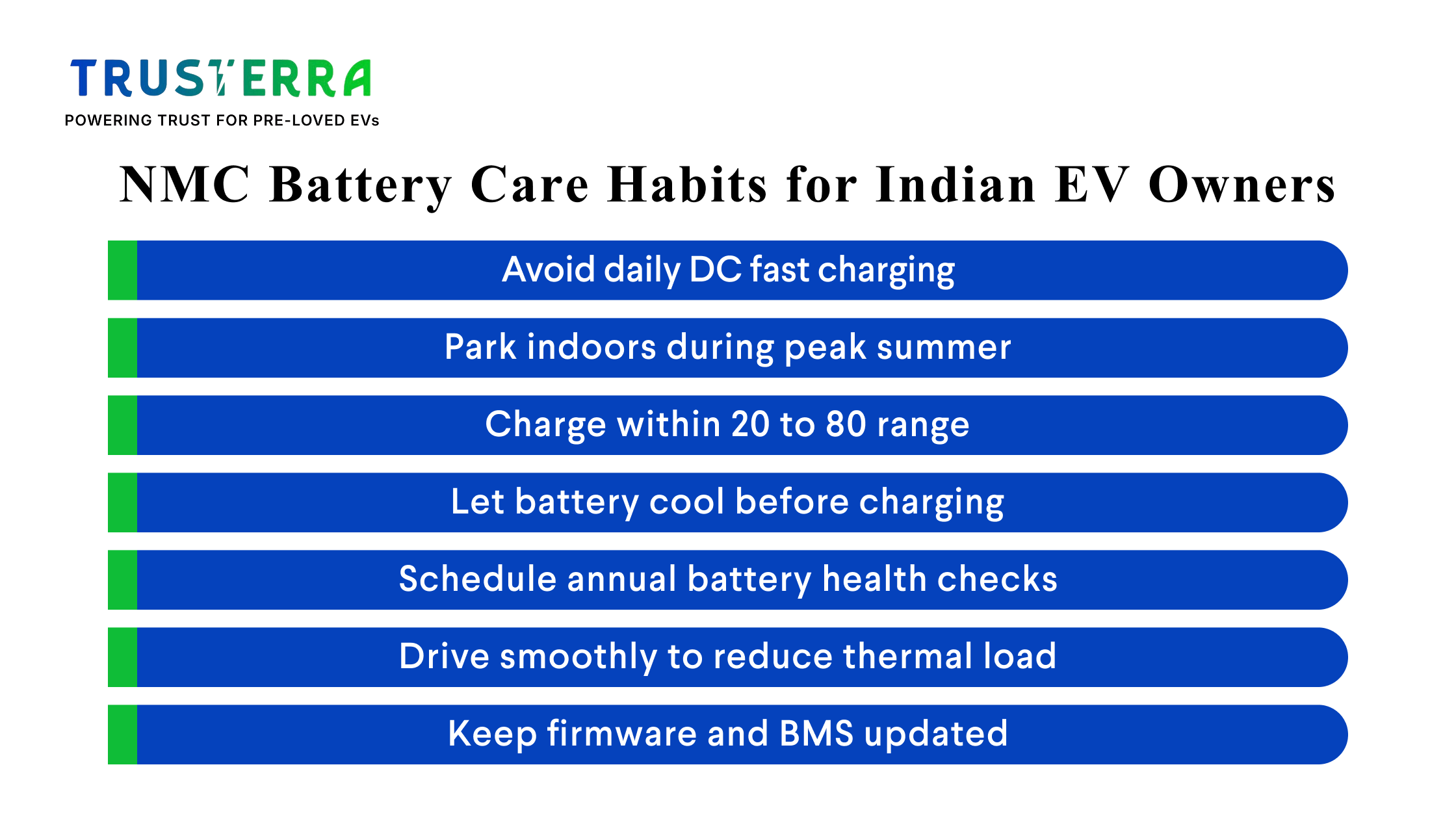
NMC batteries need careful daily handling under Indian conditions. Heat is the main concern, so charging habits, parking choices, and driving style matter more than for LFP packs. A few small changes protect the cells across years of ownership.
- Avoid daily fast charging because repeated high-current sessions add heat that NMC chemistry handles worse than LFP packs.
- Park indoors during summer to keep an ambient temperature lower and reduce calendar ageing of NMC cells during long days.
- Charge between twenty and eighty per cent for daily use, since NMC cells suffer most when held at full charge.
- Avoid charging right after long drives to let the pack cool down naturally before adding more heat from charging.
- Schedule yearly battery health checks to catch capacity fade early and plan future repairs or warranty claims confidently.
How does NMC chemistry affect used EV pricing?
NMC chemistry affects used EV pricing through three signals. First, buyers know NMC packs lose capacity faster under Indian heat. This raises the importance of a documented SoH report. Without proof of health, NMC EVs sell at a steeper discount.
Second, replacement cost concerns weigh on the buyer. An NMC pack costs more to replace than an LFP one, and the buyer factors this risk into the offer. A four-year-old NMC EV with weak battery health can lose 30 to 40 percent of its value.
Third, premium NMC EVs hold their brand value through features, range, and badge appeal. A well-maintained NMC EV from a top OEM still commands strong resale interest. The key is battery transparency through a verified report at the point of sale.
How does TrusTerra grade used EVs with NMC batteries?
TrusTerra grades NMC-powered used EVs through a chemistry-specific assessment built into the TruEV Score™. The platform accounts for the steeper voltage curve, thermal history, and faster degradation pattern of NMC cells, rather than applying one generic standard across all chemistries.
The assessment combines doorstep inspection, BMS data extraction, AI-driven valuation, and verified reporting. TrusTerra also factors in calendar age, charging history, and climate exposure where data is available. The result is a transparent score that reflects how the specific NMC pack has aged.
For Indian buyers and sellers, this means an NMC EV is priced according to its real condition. A well-cared-for Kona Electric or MG ZS EV gets credit for its strong battery health. A poorly maintained pack is flagged before any deal is closed.
Get a verified TruEV ScoreTM for your NMC-powered EV and sell with confidence.