


What Is an LFP Battery?
LFP batteries power many popular EVs in India. Learn how they work, why they last longer, and how they affect used EV resale value.
What Is an LFP Battery and Why Does It Matter for EVs?
Ask an EV owner in Delhi what worries them most about summer, and battery heat is often the answer. This is one reason LFP has become the preferred chemistry for a growing number of Indian EV brands.
LFP, short for Lithium Iron Phosphate, gets its name from the chemistry inside each cell's cathode. It is one of two dominant battery types in electric vehicles today, the other being NMC, which relies on nickel, manganese, and cobalt.
Inside an LFP cell, energy is stored as lithium ions move between the cathode and anode during charging. What sets this chemistry apart is stability. The iron phosphate cathode resists breaking down under heat or physical damage, which lowers the risk of thermal runaway, the chain reaction behind most battery fires.
In simple terms, LFP is the safer, longer-lasting, lower-energy-density cousin of NMC. It does not pack as much range into every kilogram, but it survives more charge cycles and tolerates Indian summers better than most alternatives on the market today. For a country where ambient temperatures regularly cross 45°C, that tradeoff is starting to look less like a compromise and more like common sense.
Key Takeaways:
|
How does an LFP battery work inside an EV?
An LFP battery moves lithium ions between two electrodes to store and release energy. The cathode is made of lithium iron phosphate. The anode is usually graphite. During charging, ions move from the cathode to the anode and reverse during driving.
- Cathode Made of Iron Phosphate: The cathode material is the key difference. Iron phosphate is chemically stable and resists breaking down under heat or impact. This is why LFP packs are far less likely to catch fire compared with older lithium chemistries used in electronics.
- Graphite Anode With Lithium Storage: During charging, lithium ions slide into the graphite anode and stay there until the EV starts driving. The anode releases the ions back through the electrolyte. This back-and-forth motion powers the motor via the inverter.
- Stable Electrolyte Solution Inside: The liquid electrolyte carries ions between the two electrodes. In LFP cells, the chemistry stays stable across a wider temperature range. The electrolyte does not break down quickly, which protects the cell from internal short circuits over years.
- Battery Management System Control: A battery management system, often called BMS, controls voltage, current, and temperature across all cells. It balances each cell during charging and prevents overuse. LFP packs work well with BMS because their voltage curve is flat across most of the charge range.
What are the main advantages of LFP batteries for EV owners?
LFP batteries bring a clear set of advantages for everyday Indian EV ownership. The chemistry favours safety, lifespan, and predictable performance over peak range. For most city commuters and fleet operators, this trade-off works well.
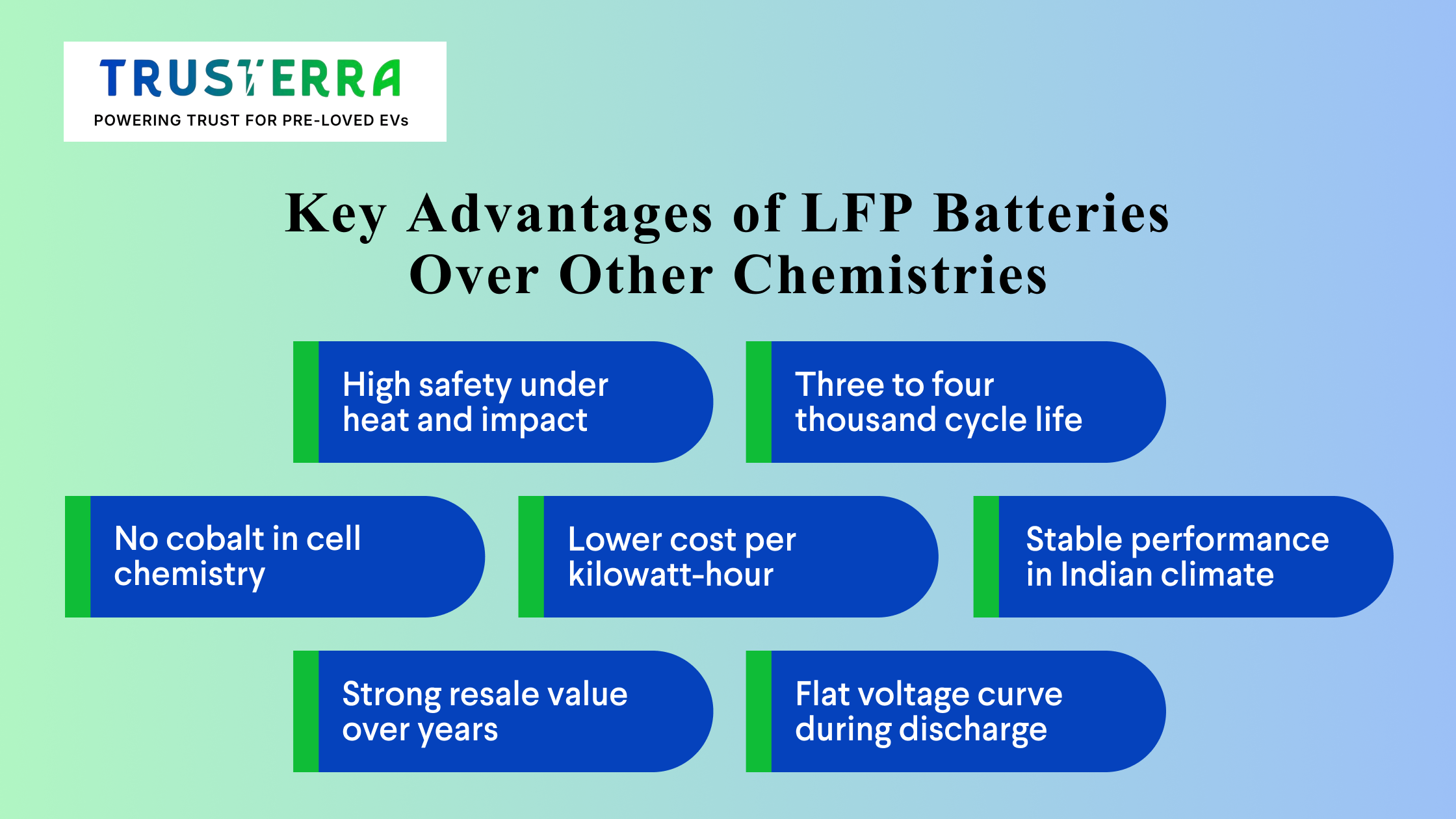
- Higher thermal stability means LFP cells stay safe in Indian summers and resist thermal runaway under heat stress.
- Longer cycle life allows LFP packs to handle three to four thousand charge cycles before noticeable degradation.
- Lower replacement risk keeps total ownership cost down, which improves resale value in the used EV market.
- No cobalt content removes dependence on a costly mineral with supply chain concerns and ethical sourcing issues.
- Flat voltage curve delivers steady power output across most of the battery's usable range during a drive.
What are the drawbacks of LFP batteries you should know?
LFP batteries also come with trade-offs. The biggest is lower energy density, which means an LFP pack holds less energy per kilogram than an NMC pack. This translates to more weight for the same driving range, affecting handling and efficiency.
Cold weather performance is another concern. LFP cells lose more usable range below 10°C. While this affects northern Indian winters, it matters more for European or hilly markets. Indian metros and southern cities see this issue less often through the year.
Charging speed at very high power levels can also drop slightly compared with NMC. For most Indian users charging overnight or at 50 to 60 kW DC fast chargers, this difference does not matter much in real-world daily use.
Which Indian EVs use LFP batteries today?
Several EV makers in India have shifted to LFP chemistry across mass-market models. The choice reflects a focus on safety, lifespan, and cost. Buyers comparing used EVs should know which models carry LFP packs versus other chemistries.
| Brand | Model | Battery Type | Approx. Pack Size |
| Tata Motors | Tigor EV, Punch EV | LFP | 21 to 35 kWh |
| MG Motor | Comet EV, Windsor EV | LFP | 17 to 38 kWh |
| BYD | Atto 3 | LFP (Blade) | 60.5 kWh |
| Citroën | eC3 | LFP | 29.2 kWh |
| Mahindra | XEV 9e, BE 6 | LFP | 59 to 79 kWh |
LFP adoption has grown across the Indian EV market through 2024 and 2025. For used EV buyers, this means the second-hand pool of LFP-powered cars will widen quickly over the next few years across the country.
How long does an LFP battery last in real Indian conditions?
LFP batteries can deliver 8 to 15 years of useful life under typical Indian use. Several factors decide where a specific pack lands within that range. Climate, charging speed, daily usage, and depth of discharge each play a clear part.
- Charge Cycle Count Capacity: A typical LFP pack handles around three thousand to four thousand full charge cycles before reaching 80 percent SoH. For an owner doing one cycle per day, this points to around eight to ten years of strong daily performance.
- Daily Charging Pattern Effect: Slow overnight charging at home stretches LFP battery life far beyond fast-charge-heavy usage. LFP handles fast charging better than NMC, yet daily DC fast charging still adds extra heat stress to cells over months of repeated sessions.
- Indian Summer Heat Stress: LFP holds up well under heat compared with NMC, which gives Indian owners an edge. Even so, parking in the shade and avoiding charging right after long highway drives help protect cells during the harsher months of the year.
- Depth of Discharge Range: Staying within 20 to 90 percent for daily use extends battery life. LFP tolerates deeper discharges better than NMC, which is why some OEMs allow full 100 percent charging on LFP packs without warranty concerns.
Why does LFP chemistry affect used EV resale value?
LFP chemistry shapes used EV resale in three quiet ways. First, longer cycle life means a five-year-old LFP pack often holds more usable capacity than an NMC pack of the same age. Buyers value this directly during price negotiation.
Second, lower replacement risk over the next ownership cycle makes LFP cars easier to finance. Lenders see LFP residual value as more predictable. This expands the buyer pool and reduces pressure on sellers to accept low cash-only offers from local dealers.
Third, safety perception matters in the resale market. LFP cells are less prone to thermal events, which gives second buyers extra peace of mind. As the Indian EV market matures, LFP-equipped models will hold their value better than older NMC-equipped models.
How does TrusTerra evaluate LFP-powered used EVs?
TrusTerra evaluates LFP-powered EVs through a chemistry-aware assessment process. The platform reads data from the battery management system, accounts for the flat voltage curve of LFP cells, and adjusts SoH calculations to reflect LFP-specific ageing patterns instead of generic models.
This matters because a standard test calibrated for NMC packs can misread LFP behaviour. TrusTerra's TruEV™ Score handles both chemistries through tuned algorithms. The result is a fair, transparent rating that reflects actual battery condition, not a one-size-fits-all number from older tools.
For Indian buyers and sellers of LFP EVs, this changes the resale process. The TruEV ScoreTM becomes a shared reference point during negotiation. Whether the car is a Tata Tigor EV or a BYD Atto 3, the score speaks the truth.
Get a verified TruEV ScoreTM for your LFP-powered used EV today.