


What is Battery Degradation in EVs
Battery degradation reduces an EV's range and resale value. Learn what causes it, how to measure it, and how to slow it down before you sell.
What Is Battery Degradation in Electric Vehicles?
Battery degradation is the slow loss of an electric vehicle battery's ability to store and deliver energy. Over years of use, the battery holds less charge than when it was new. This shows up as reduced driving range.
Every lithium-ion battery loses some capacity with age, even when sitting unused. The chemistry inside the cells changes after each charge and discharge. These small chemical shifts add up across thousands of cycles over the vehicle's life.
For used EV buyers in India, degradation matters more than odometer readings. A four-year-old EV with strong battery health can outperform a two-year-old one with poor charging habits. Health beats age in EV resale decisions.
Key Takeaways:
|
What causes an EV battery to degrade faster?
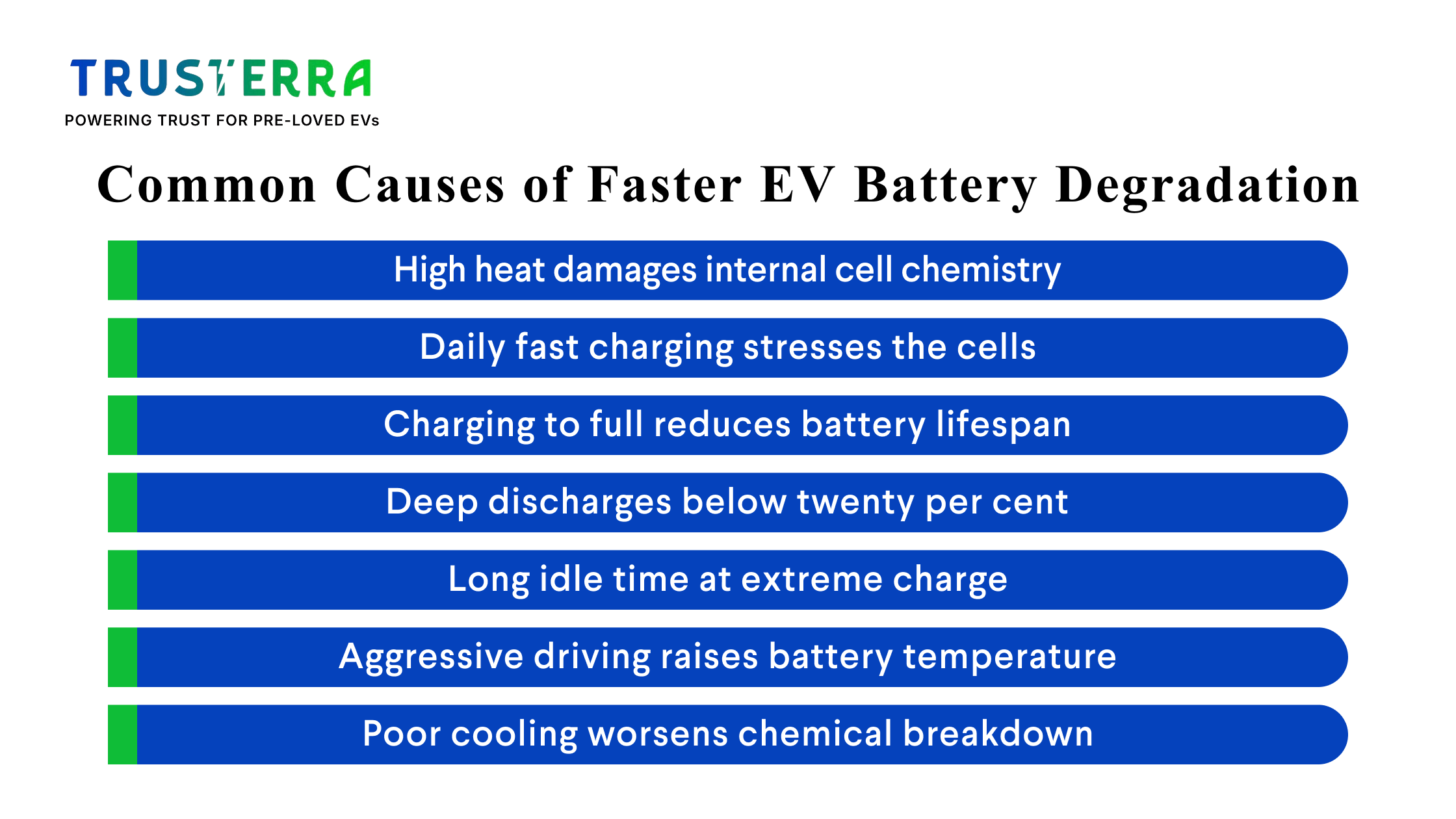
Several factors push battery degradation past its normal pace. Heat is the biggest culprit under Indian conditions. Charging habits, depth of discharge, calendar age, and storage state all play a role in how the cells hold up.
- High Ambient Temperature: Indian summers regularly cross 40°C across most cities. Heat accelerates chemical reactions within the battery, breaking down the electrolyte and damaging the cathode. Parking in the shade and avoiding peak-afternoon charging help reduce this constant thermal stress.
- Frequent DC Fast Charging: Fast chargers push large amounts of current into the battery within minutes. This raises internal heat and stresses the cells. Daily fast charging shortens battery life compared with overnight slow charging at home via a standard AC outlet.
- Charging To Full Often: Keeping the battery at 100 percent for long periods increases voltage stress on the cells. Most EV makers suggest charging to 80 percent for daily use. Reaching full charge should be saved for long highway trips only.
- Deep Discharges Below 20 Percent: Running the battery very low strains the cells, especially when this happens often. Staying within the 20 to 80 percent window for most charge cycles protects the battery and extends its useful life across years of ownership.
How can you spot signs of battery degradation in an EV?
Battery degradation does not appear overnight. The signs build up across months of use. Most owners notice it through changes in driving range, charging behaviour, or the way the vehicle responds during normal city commutes.
- Reduced driving range is the clearest sign, with the car covering fewer kilometres on a full charge than before.
- Faster charging cycles can mean the battery now accepts less energy because it stores a smaller total capacity.
- Quicker percentage drops during driving suggest the battery management system is recalibrating to a shrinking usable window.
- Heat during charging that feels stronger than usual points to internal resistance rising inside ageing battery cells.
- Inconsistent range estimates on the dashboard show that the battery can no longer predict its own remaining capacity well.
How is battery degradation measured in real numbers?
Battery degradation is measured by State of Health (SoH). SoH compares the battery's current usable capacity to its original capacity. A reading of 90 percent means the battery now holds nine-tenths of its original energy.
Specialised tools read data from the battery management system. They check voltage curves, internal resistance, charge acceptance, and cell balance. Workshop-grade scanners can also test individual cell groups inside the pack and find weak spots before the damage spreads further.
For Indian used EV buyers, a written SoH report carries more weight than a dealer's verbal assurance. According to the IEA Global EV Outlook 2024, modern EV battery lifespans now often outlast typical vehicle ownership cycles in most markets.
How does battery degradation affect resale value in India?
Battery degradation hits used EV pricing harder than mileage or model year. A car with a weak battery loses range, charging efficiency, buyer confidence, and dealer leverage at once. Sellers without health reports often face steep price cuts during negotiation.
- Lower Usable Range: A degraded battery means fewer kilometres per charge. Buyers in cities like Bengaluru or Pune calculate daily commute needs against real-world range. A vehicle that cannot meet daily distance targets receives lower offers from informed buyers each time.
- Higher Buyer Hesitation: Without proof of battery health, buyers assume the worst case. The fear of expensive replacement reduces offers across the market. A documented SoH report can shift the conversation from suspicion to confidence and protect the seller's asking price.
- Reduced Financier Confidence: Lenders price used EV loans based on residual value. A car with unclear battery condition receives lower loan eligibility. This shrinks the buyer pool and forces the seller to accept cash-only offers at reduced rates from local dealers.
- Wider Price Gaps Across Same Models: Two identical EVs of the same year can sell at different prices in India. Battery health is the deciding factor here. This gap will widen as the used EV market matures across metro and tier-two cities.
What daily habits help slow down battery degradation in EVs?
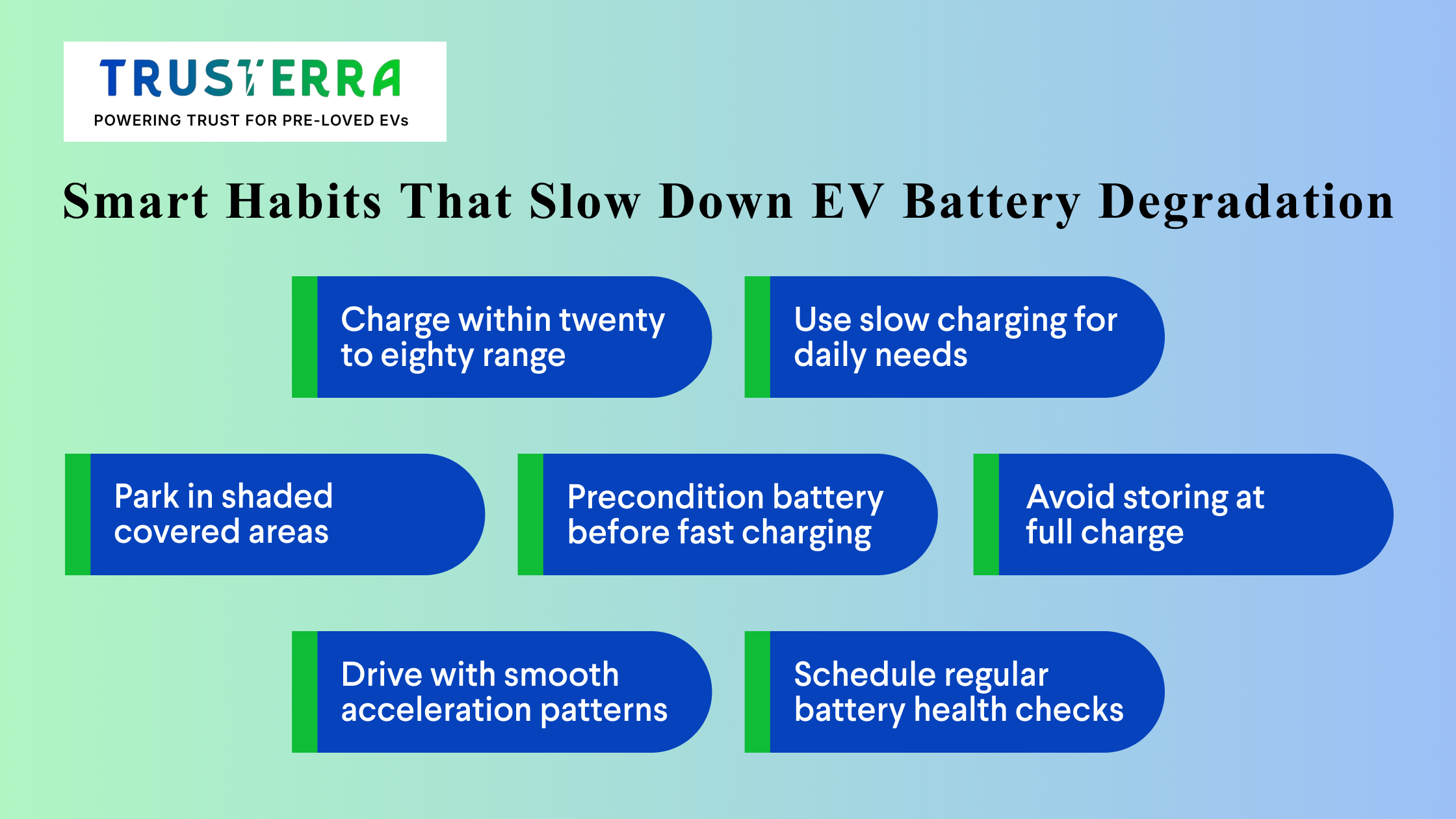
Battery degradation cannot be stopped, but its pace can be slowed with smart daily habits. Small changes in charging routine and driving style protect cell chemistry. Owners who follow these habits see longer range and higher resale value.
- Charge between twenty and eighty per cent for daily use to keep voltage stress on the cells within a healthy range.
- Avoid fast charging when possible because slow overnight AC charging produces less heat and protects cell chemistry over time.
- Park in shaded or covered areas during Indian summers to reduce ambient heat exposure on the battery pack.
- Precondition the battery before fast charging in cooler months to let the cells reach efficient operating temperature first.
- Avoid leaving the EV idle at full or empty charge for weeks, since both states accelerate chemical wear inside cells.
Why should used EV buyers check battery degradation before purchase?
Buying a used EV without checking battery health is a financial risk. The battery often represents 30% to 40% of an EV's total cost. A weak pack may need replacement within a few years, erasing the savings from a used purchase.
A proper degradation check reveals real range, true capacity, and remaining warranty cover. It also helps the buyer judge whether the asking price matches the actual condition. Without this check, buyers rely on age, mileage, and seller claims with no proof.
Indian buyers face an added challenge because resale standards are still developing across the market. A verified battery report from a trusted platform protects both sides of the deal. It reduces disputes, supports financing, and improves long-term ownership clarity.
How does TrusTerra help you understand battery degradation?
TrusTerra is India's first AI-backed used-EV marketplace built on the premise that battery health should be measurable. Through the TruEV™ Score, every listed vehicle carries a clear health rating that reflects real degradation, not surface checks.
The platform combines doorstep inspection, battery management system data, AI-driven valuation, and verified reporting. Buyers see actual SoH numbers before deciding. Sellers benefit from fair pricing based on the real condition of the battery, rather than dealer pressure or guesswork during a face-to-face negotiation.
For Indian EV owners, this changes the resale conversation. Battery degradation stops being a hidden risk and becomes a documented number. Whether selling a personal car or sourcing inventory as a dealer, TrusTerra brings clarity to every used EV deal.
Get your EV's TruEV ScoreTM today and sell with full battery confidence.