


What Is Battery Cycle Life in Electric Vehicles?
Battery cycle life decides how long your EV battery lasts. Learn how cycles are counted and how they shape used EV resale value.
What Is Battery Cycle Life in Electric Vehicles?
Two EVs can carry the exact same battery capacity on paper and still age at completely different rates. The number that actually decides how long a pack stays useful is cycle life, and most buyers never think to ask about it.
Battery cycle life is the total number of full charge-discharge cycles a battery can complete before its capacity falls below a defined threshold. For most EV batteries, the threshold is 70 to 80 percent of the original capacity, marking the end of usable life.
One full cycle equals draining the battery from 100 percent to 0 percent and charging it back to full. In real driving, this rarely happens in one session. Two half-cycles of 50 percent each add up to one full cycle in counting.
Cycle life is one of the strongest indicators of battery longevity. A pack rated for 4,000 cycles handles far more years of daily use than one rated for 1,500. This single number shapes total ownership cost and resale value.
Key Takeaways:
|
How is a battery charge cycle counted in practice?
A charge cycle is counted by total energy moved through the battery, not by how many times you plug it in. The battery management system tracks cumulative charge and discharge to add up to one full cycle, regardless of the combination of partial sessions.
- Full Discharge and Recharge: When the battery goes from 100 percent down to zero and back to full, that is one complete cycle. This happens rarely in daily EV use, since most drivers top up before the pack runs low on a regular basis.
- Two Half Cycles Equal One Full: Charging from 50 to 100 percent twice equals one full cycle. The BMS adds the energy moved across sessions. Daily partial charging is gentler on the battery, even though the total cycle count adds up the same way.
- Multiple Small Top-Ups Counted Together: Five small 20 percent top-ups add up to one full cycle. Frequent small charges are easier on cell chemistry compared with deep discharges. This is why home charging from 60 to 80 percent every night protects long-term cycle health.
- Battery Management System Tracking Total: The BMS keeps a running tally of energy throughput across the battery's life. The cycle counter only moves up when full equivalent energy has passed through. Some EV apps now show this count for owner reference.
How many cycles can different EV battery types handle?
Cycle life varies across battery chemistries. LFP cells lead the segment, while older NMC cells fall behind. The number shapes how long a battery delivers strong range before noticeable capacity loss, which then affects total ownership cost.
Battery Chemistry | Typical Cycle Life | Approx. Years of Daily Use |
LFP (Lithium Iron Phosphate) | 3,000 to 4,500 cycles | 10 to 15 years |
NMC (Nickel Manganese Cobalt) | 1,500 to 2,500 cycles | 6 to 10 years |
NCA (Nickel Cobalt Aluminium) | 1,000 to 2,000 cycles | 5 to 8 years |
LTO (Lithium Titanate) | 7,000 to 20,000 cycles | 20 plus years |
These numbers reflect typical lab-tested cycle counts. Real-world figures vary with climate, charging habits, and depth of discharge. Indian heat tends to cut cycle life by 10 to 20 percent compared with cooler global markets like Europe or Canada.
What factors reduce a battery's cycle life faster?
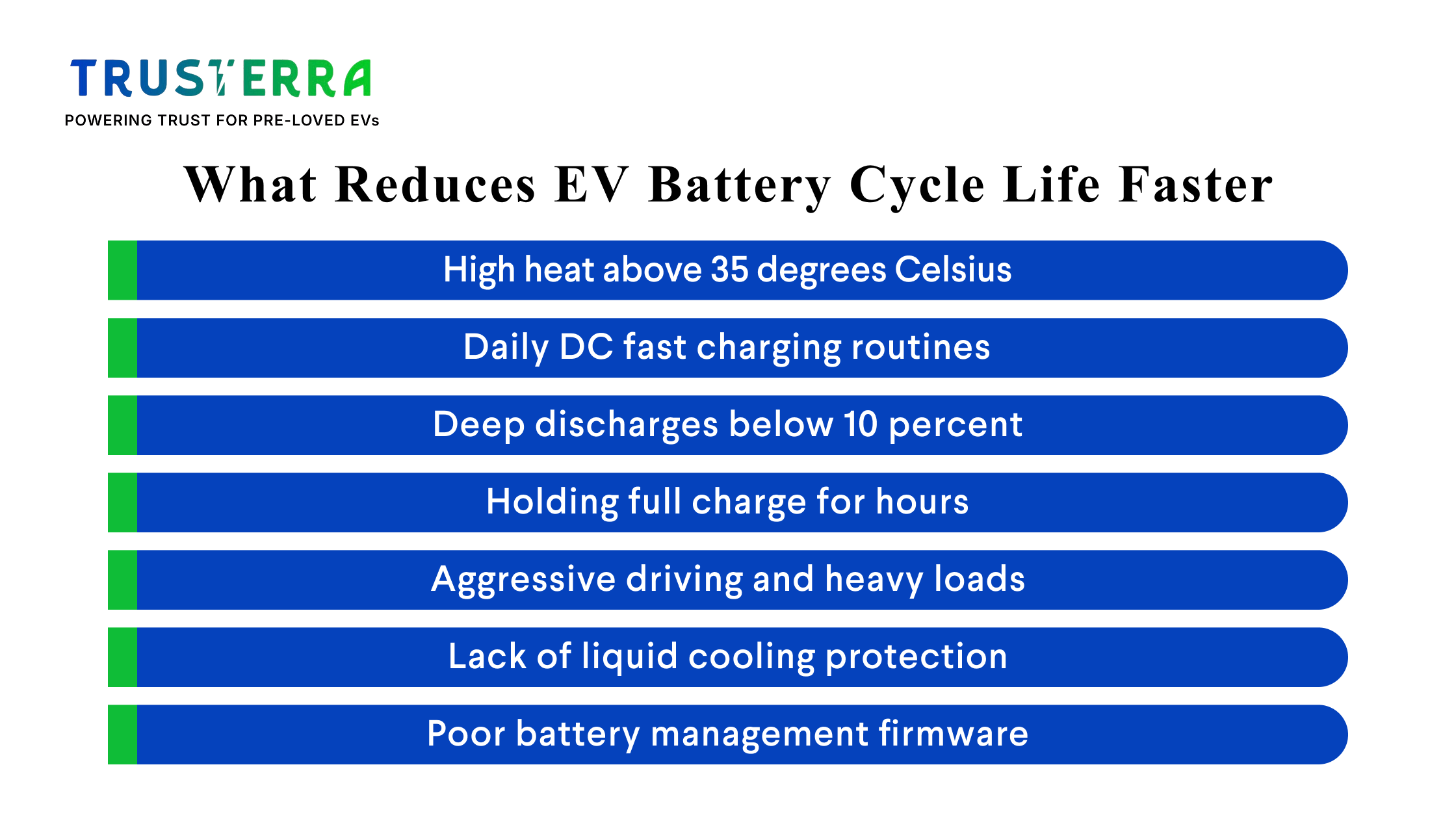
Cycle life shrinks under stress. Several factors push it down faster than expected. Indian owners need to know which habits help and which ones quietly cut the battery's lifespan over months of daily city and highway use.
- High operating temperatures above 35 degrees Celsius double the chemical wear inside cells across every full charge cycle.
- Frequent fast charging generates extra heat inside the pack, which speeds up degradation per cycle compared with slow charging.
- Deep discharges below 10 percent strain the cells more than shallow cycles, shortening total cycle count over time.
- Holding at full charge for long hours creates voltage stress, which damages the cathode and reduces total cycle count.
- Heavy load driving with aggressive acceleration draws more current per kilometre, adding extra wear that compounds across daily commutes.
How does cycle life translate into years of EV ownership?
Cycle life converts to ownership years based on daily driving distance. An average Indian EV owner drives about 30 to 50 kilometres a day, which works out to roughly one full cycle every three to five days for most mid-range packs.
For an LFP pack rated at 4,000 cycles, that translates to around 30 to 50 years of theoretical use. Calendar ageing limits the useful life to 12 to 15 years. The cycle count rarely runs out before the calendar does.
NMC owners doing high mileage will see different math. A delivery driver covering 150 kilometres a day completes one cycle every other day. An NMC pack rated at 2,000 cycles may reach end of life in six to eight years for that driver.
Why should used EV buyers check cycle count before buying?
A cycle count check indicates how much battery life remains in the pack. Two cars of the same age can carry very different cycle counts based on past usage. This single number reveals more about the battery than the odometer readings do.
- Cycles Reveal True Battery Age: A three-year-old EV with 1,800 cycles has been used far harder than one with 700 cycles. The lower number signals gentler use and stronger remaining capacity. Cycle count tells the real story behind a clean odometer.
- Fleet Use Burns Cycles Quickly: A used EV from a delivery fleet or ride-share business may have crossed 2,500 cycles within four years. Such packs sit close to end of life. Buyers should know the vehicle's past use before agreeing to a price.
- Cycles Predict Future Range: Cycle count predicts how soon the battery will need replacement. A buyer planning seven more years of ownership should buy a pack with at least 70 percent of its cycle budget remaining for safety.
- Cycles Support Better Pricing: Cycle data gives the buyer leverage during negotiation. A documented low cycle count justifies a higher asking price for the seller. A high cycle count gives the buyer reason to negotiate the price downwards.
Can owners extend battery cycle life through better habits?
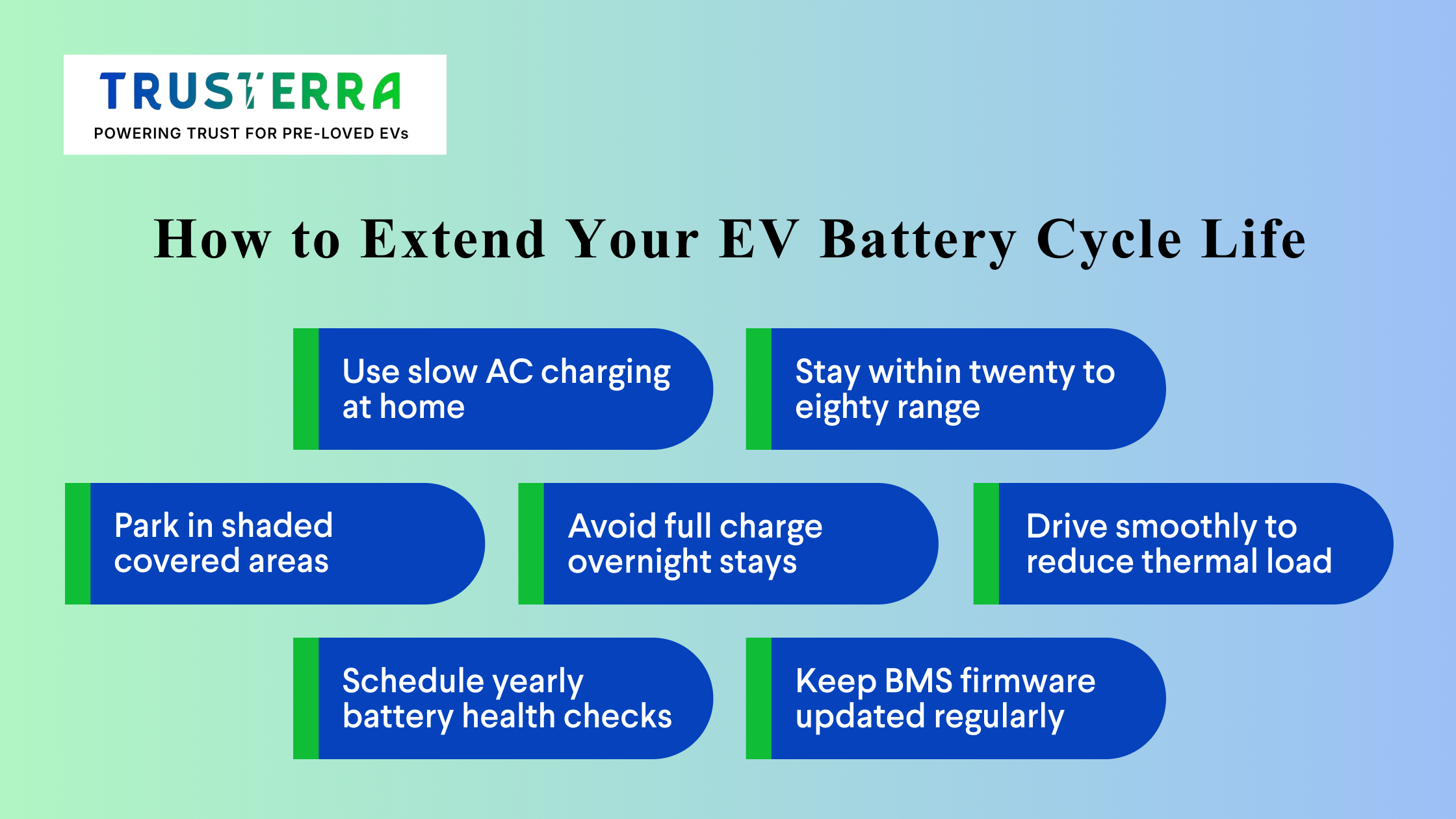
Yes, simple daily habits can stretch cycle life beyond factory specifications. Indian EV owners who stay within smart charging routines often see actual cycle counts exceed lab estimates. The key is to reduce stress during charging, driving, and storage.
Slow AC charging at home is the single biggest extender. Each slow cycle produces less heat than a DC fast-charge session. Owners who plug in overnight and avoid daily 30-kW charging can add years of usable life to the pack.
Staying within the 20 to 80 percent window matters too. Each cycle within this range counts as a shallow cycle, which the cells handle far better than full deep cycles. When combined with shaded parking, these habits can extend real-world cycle life by 20 to 30 percent.
How does TrusTerra track and report EV battery cycle life?
TrusTerra tracks cycle life through direct battery management system data and inspection-based estimation. During every doorstep evaluation, the platform pulls cycle counters, charge logs, and SoH metrics. This data feeds into the TruEV Score™, giving buyers a verified read on remaining battery budget.
The platform translates raw cycle data into plain-language insights. Instead of showing a confusing 1,847 cycle number, the TruEV ScoreTM expresses it as a percentage of expected lifespan used, with remaining years projected based on the owner's driving pattern.
This matters because cycle data is rarely shared in private used EV deals. Sellers may not know it. Buyers cannot access it. TrusTerra brings this hidden number into the open, allowing both parties to agree on a fair price backed by real evidence.
Get your EV's complete cycle life report through TrusTerra's TruEV ScoreTM today.