


What is Thermal Management in EVs?
Learn what thermal management means in EV batteries, how cooling systems affect range, safety, battery life, and used EV value.
What is Thermal Management?
Thermal management is the system that helps keep an EV battery within a safe and useful temperature range. It uses cooling, heating, sensors, and software controls. This matters because lithium-ion batteries perform best when temperature stays controlled during charging, driving, and parking.
For used EV buyers, thermal management is important because heat history affects long-term battery health. A vehicle used in hot cities or frequent fast charging may show more battery stress. The condition of the cooling system can therefore influence range confidence and resale value.
Research from NREL notes that higher temperatures degrade lithium-ion batteries faster, while low temperatures reduce power and energy capability. That is why thermal management affects safety, range, reliability, and battery life in EVs.
Key Takeaways:
|
What does thermal management mean in an EV battery?
Thermal management means controlling battery temperature during charging, driving, and rest periods. The system may cool or warm the pack depending on conditions. Its goal is to protect safety, maintain performance, and reduce battery ageing across the EV’s life.
- Battery protection: Thermal management helps prevent the pack from overheating or freezing. This supports battery stability during daily driving, long trips, and charging sessions.
- Range support: Temperature affects how much energy the battery can deliver. A good system helps reduce range swings caused by heat, cold, or repeated high-load use.
- Charging support: Batteries charge more effectively when they stay within a suitable temperature range. Thermal management can prepare or protect the pack during fast charging.
- Resale value: Buyers trust EVs more when cooling and heating systems work well. Strong thermal performance can support better battery confidence during resale.
How is active thermal management different from passive thermal management?
Active thermal management uses powered systems such as pumps, fans, liquid cooling loops, or controlled heating. Passive thermal management relies on natural convection, conduction, and radiation without consuming parasitic power. They leverage structural pack design, heat spreaders, and Phase Change Materials (PCMs) to absorb heat, offering high reliability and lower cost but limited cooling capacity under extreme conditions.
| Difference | Active thermal management | Passive thermal management |
| Main method | Uses powered cooling or heating components. | Uses materials, airflow, and pack design. |
| Temperature control | Responds faster under heavy use. | Works without complex powered systems. |
| Cost and complexity | Higher cost and more service points. | Lower complexity with fewer moving parts. |
| Fast charging support | Better suited for repeated fast charging. | Less capable under high heat loads. |
| Used EV check | Inspect coolant, pumps, and alerts. | Check heat exposure and pack condition. |
Why does thermal management matter in India?
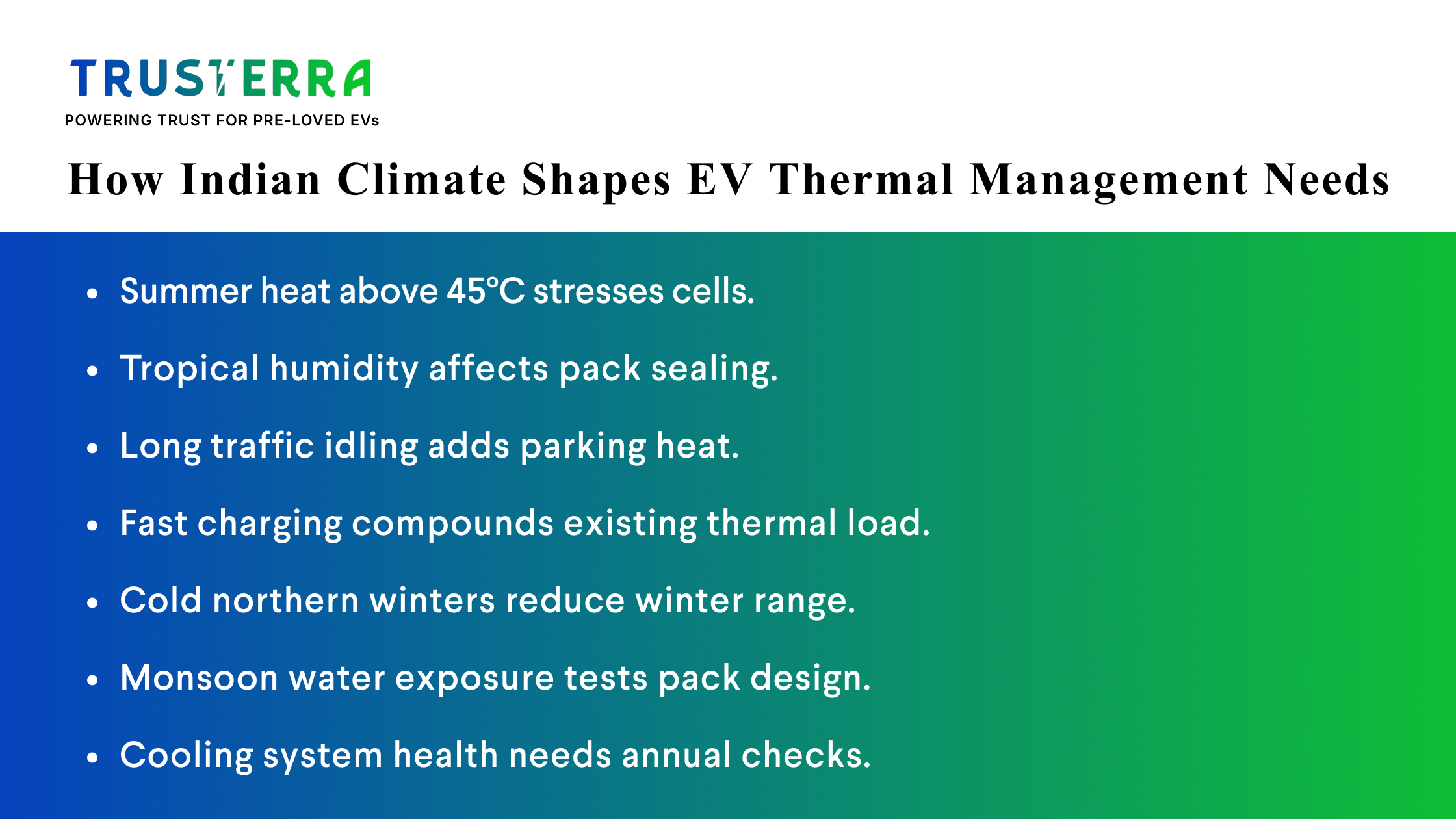
Thermal management matters in India because many EVs operate in heat, traffic, and uneven charging conditions. High ambient temperature can raise battery stress during charging and driving. Used EV buyers should read thermal history as part of battery condition, especially in hot cities.
- Indian summers add battery stress when vehicles sit in the sun or charge during peak heat.
- Stop-start traffic creates heat load because the EV uses energy while cooling the cabin.
- Frequent fast charging adds temperature stress when cooling systems cannot remove heat fast enough.
- Poor cooling can reduce confidence in range, battery life, and long-term ownership cost.
- Thermal records support resale value when they show stable behaviour and clean service history.
How does thermal management affect battery life and range?
Thermal management affects battery life because temperature influences chemical ageing inside cells. Excess heat can speed up capacity loss, while cold can reduce power and slow charging. A stable temperature range helps the battery deliver more predictable range and stronger long-term usability.
A good thermal system does more than prevent serious faults. It helps reduce everyday stress during fast charging, hill driving, heavy load, and hot parking conditions. This can help slow degradation across years of ownership.
For used EV buyers, the key question is practical. Does the EV still manage temperature well under normal Indian use? A battery report, service history, and charging behaviour can help answer that question before purchase.
What cooling methods are used in EV batteries?
EV batteries use different cooling methods depending on model, battery size, price point, and performance needs. Air cooling, liquid cooling, phase-change materials, and hybrid approaches are prevalent across the market. Used EV buyers should understand the method before judging long-term range confidence.
- Air cooling: Air cooling uses fans or airflow channels to remove heat from the pack. It can be simpler and cheaper, but may struggle under repeated fast charging or very hot conditions.
- Liquid cooling: Liquid cooling moves coolant through channels near battery modules. It can offer stronger temperature control, especially in larger EVs or vehicles designed for fast charging.
- Phase change materials: Some designs use materials that absorb heat as they change phase. These systems can smooth temperature spikes, although they depend on careful pack engineering.
- Hybrid systems: Hybrid thermal systems combine two methods for better control. They may use liquid cooling with materials or airflow support to balance cost, weight, and performance.
What warning signs suggest thermal management problems?
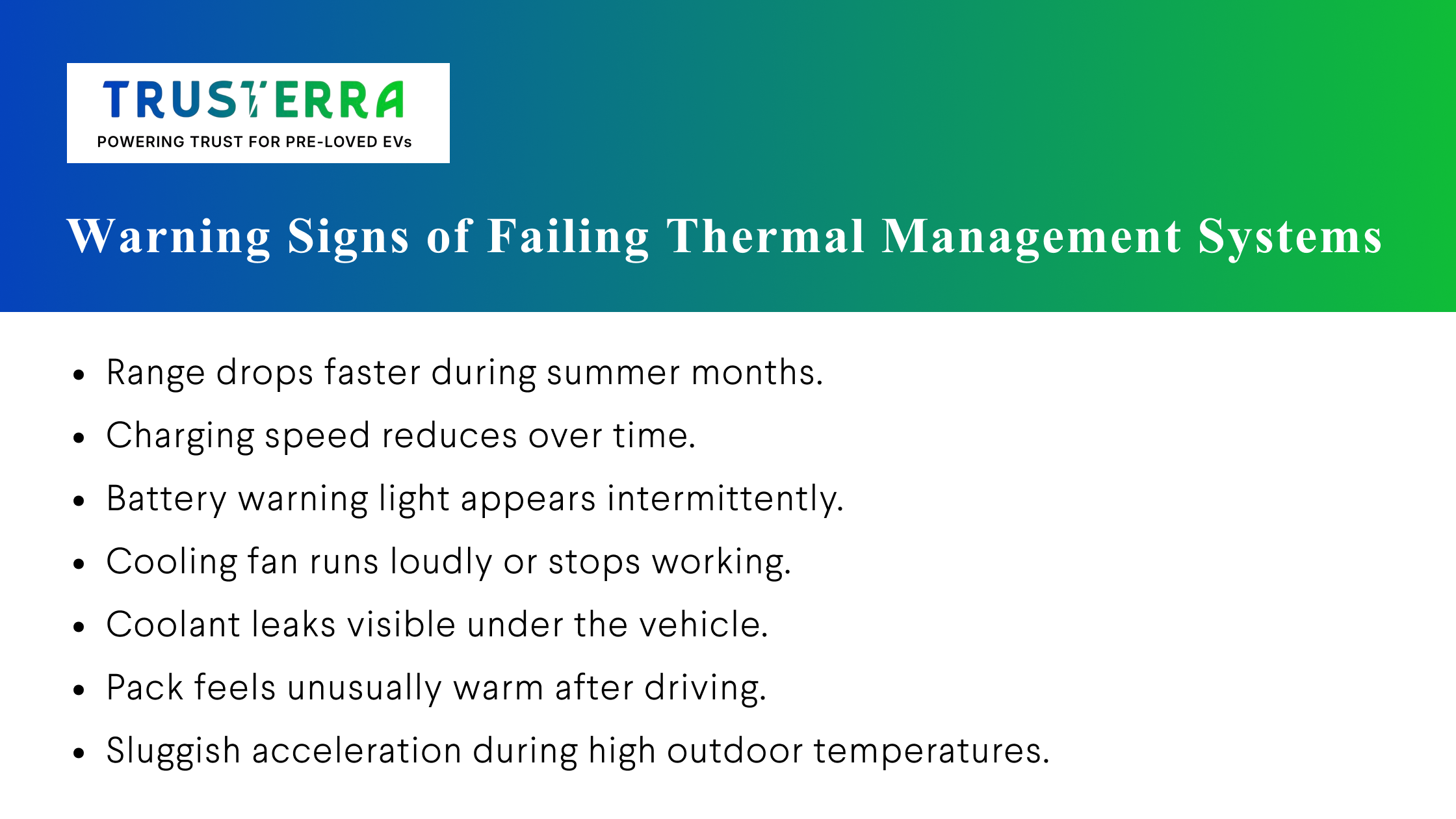
Thermal management problems can show through charging slowdown, battery warnings, sudden power limits, or larger range drops in heat. These signs may come from cooling hardware, sensors, coolant issues, or software control. Buyers should not ignore them during inspection.
- Charging slows too early when the battery or cooling system cannot manage heat load.
- Power limits appear during driving if the system protects the battery from excess temperature.
- Range drops sharply in heat when cooling load and battery stress rise together.
- Coolant warnings need inspection because leaks or low coolant can affect battery protection.
How should used EV buyers check thermal management before purchase?
Used EV buyers should check thermal management through service records, warning logs, coolant condition, and charging behaviour. A test drive alone may not reveal heat problems. A battery-led inspection gives better evidence about how the EV manages temperature in real use.
- Service records: Cooling system service records can show whether coolant, fans, pumps, or sensors received attention. Missing records create doubt when the EV has operated in hot regions.
- Charging behaviour: Buyers should ask whether fast charging slows unusually or triggers warnings. Charging problems can reveal thermal or BMS issues that are not visible from the outside.
- Dashboard alerts: Battery temperature warnings, power limits, or coolant messages need diagnostic review. They should not be dismissed as small software glitches without evidence.
- Physical checks: Inspectors should check battery underbody damage, leaks, connectors, and visible cooling components. Poor repairs can affect how heat moves through the system.
How does TrusTerra assess thermal management in used EV decisions?
TrusTerra integrates thermal management analysis directly into its broader battery intelligence framework, recognizing that thermal history and cooling efficiency are primary drivers of long-term battery cycle life, range consistency, and residual asset value. Temperature behavior and heat stress are critical parameters that directly impact key stakeholders, including buyers, sellers, dealerships, and underwriting financial institutions.
Rather than evaluating a vehicle solely through lagging indicators like odometer mileage or physical cosmetic wear, TrusTerra utilizes its proprietary TruEV Score™. This AI-driven benchmark synthesizes battery-led diagnostic signals, actual state-of-health (SoH) metrics, and contextual ownership data to deliver an objective assessment of the battery pack.
A used EV should be assessed through how it behaves, not only how it looks. TrusTerra helps make confidence in cooling, battery health, and range easier to interpret.
Book a TrusTerra inspection and review your TruEV Score™ before the heat becomes your problem.