


Battery Capacity Buffer: What Used EV Buyers Must Know
Understand what battery capacity buffer means, why EVs reserve part of the pack, and how it affects used EV range and battery life.
Battery Capacity Buffer in Electric Vehicles
Every EV battery pack stores more energy than the driver can use during daily driving. Manufacturers reserve part of the pack at the upper and lower charge limits. This reserved portion is called the battery capacity buffer, and it helps protect the battery from avoidable stress.
For used EV buyers, the buffer explains why rated capacity and actual usable capacity can differ. The buffer itself does not erode or get used to compensate for capacity loss. What matters during resale is the usable capacity available within the BMS-managed operating threshold.
TL;DR
|
What is a battery capacity buffer in electric vehicles?
A battery capacity buffer is the protected part of an EV battery that the driver cannot access during normal use. It sits above and below the displayed charge window. This reserve helps the battery avoid stressful full-charge and deep-discharge conditions.
When the dashboard shows 100 percent, the battery may still be below its absolute chemical limit. When the dashboard shows 0 percent, the pack may still hold protected energy. This gap between physical capacity and driver-accessible capacity is the buffer.
The buffer is configured to protect the cells from over-utilisation. It is not a reserve that gets consumed as the battery ages. The BMS manages the operating threshold, and the usable capacity within that threshold is what matters during used EV assessment.
- Protected reserve capacity: This is the portion of stored energy kept outside normal driver access. It protects the battery from operating too close to its upper or lower chemical limits.
- Displayed charge window: The dashboard percentage shows the range the driver can use. It does not always reveal the battery’s full physical state inside the pack.
- BMS operating threshold: The BMS manages the usable capacity window within safe voltage limits. This operating threshold is where the vehicle delivers energy for driving, charging, and daily use.
- Used EV relevance: A used EV can look healthy on the dashboard while its actual usable capacity has reduced. Diagnostics help measure the capacity available within the safe operating threshold, which supports resale valuation
How does rated capacity differ from usable capacity in an EV?
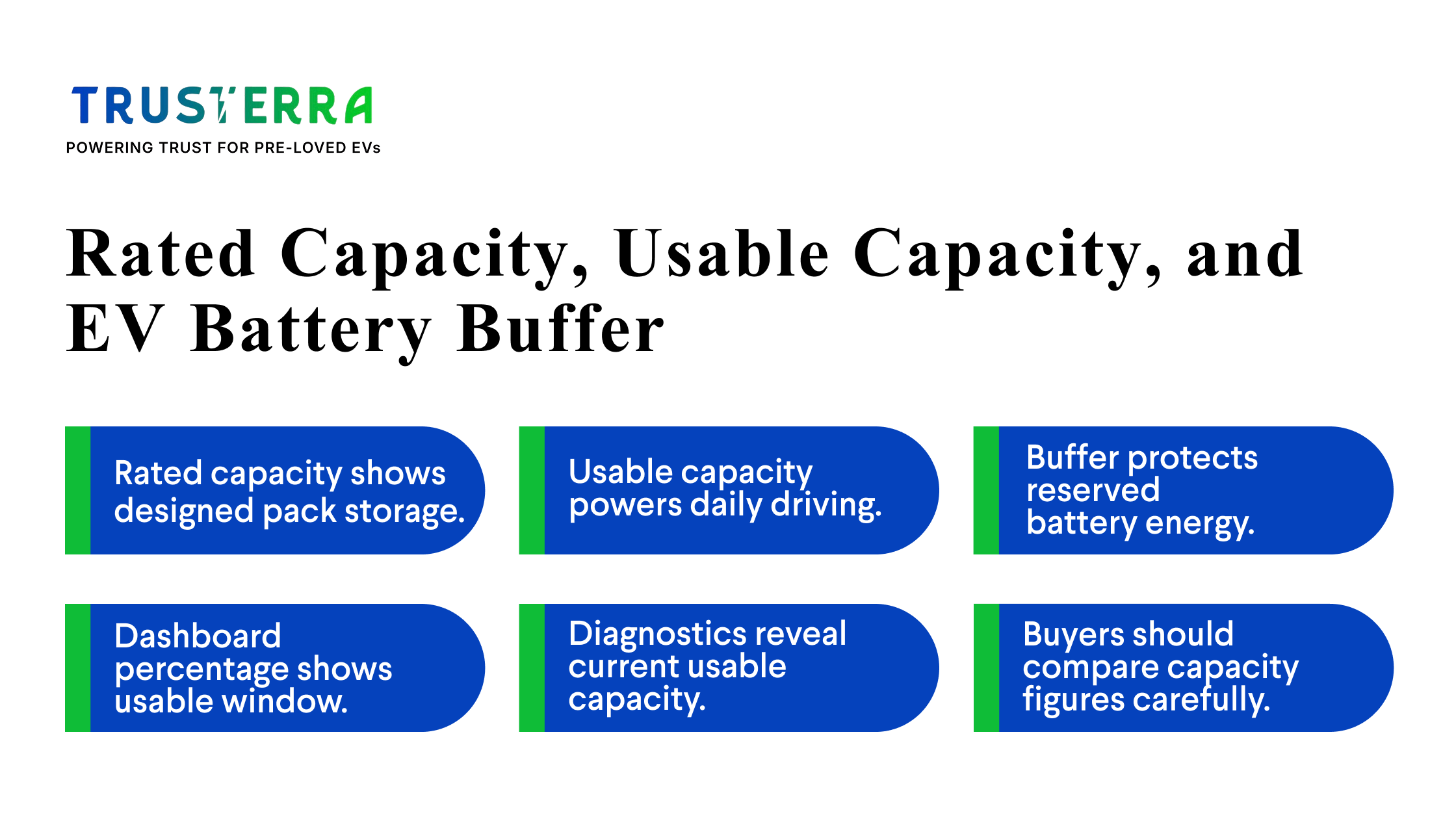
Rated capacity is the total energy the battery cells can physically store. Usable capacity is the portion of the vehicle that the driver can access for normal driving. The difference between these two figures is the battery capacity buffer.
Difference | Gross capacity | Usable capacity |
Meaning | Total physical energy inside the battery cells. | Energy available for regular driving use. |
Driver access | Not fully available during normal operation. | Available through the vehicle’s charge and discharge window. |
Battery role | Shows the pack’s design-level storage. | Supports range, charging, and daily use. |
Buffer link | Includes the protected reserve. | Excludes the protected reserve. |
Used EV relevance | Helps understand original pack design. | Helps estimate current real-world range. |
Understanding these differences is critical because EV listings often mention battery capacity without explaining which figure is being used. Buyers should know whether the listed number refers to rated pack capacity or actual usable capacity available for driving
Here are some key points to note:
- Rated capacity: The battery pack’s designed storage capacity. Rated capacity helps explain the pack's original design, but it does not indicate how much energy the driver can use on the road.
- Usable capacity: The energy available for driving within the BMS-managed operating threshold. This figure matters more for range estimates, charging calculations, and used EV pricing.
- Capacity buffer: The battery capacity buffer is the safety margin between rated and usable capacity. It protects the cells from stress near the upper and lower voltage limits.
- Specification check: Buyers should check whether a listed kWh figure refers to rated capacity or usable capacity. This prevents confusion when comparing two used EV listings.
Why do manufacturers build a buffer into every EV battery?
Manufacturers use battery capacity buffers to protect cells from the most stressful operating zones. Lithium-ion batteries age faster when they stay near absolute full charge or discharge levels.. The buffer helps keep the battery within a safer operating range during normal use.
The chemistry explains the design choice. Battery cells experience greater stress near extreme charge and discharge limits because voltage and chemical reactions become harder to control. Keeping the pack within these limits can reduce avoidable capacity loss.
The buffer also supports safety and control. It gives the Battery Management System room to manage cell differences, temperature, and voltage behaviour. This margin matters in India, where heat, traffic, and charging habits can add extra stress on the battery.
- Protection from voltage extremes: The buffer keeps cells away from absolute high-voltage and low-voltage zones. This helps reduce stress during full charging and deep discharge conditions.
- BMS threshold management: Cell balancing happens within the BMS-managed operating threshold. The buffer itself does not perform balancing or get used for balancing activity.
- Safety operating margin: A protected reserve gives the battery system greater control during charging, driving, and fault response. It does not remove all risk, but it supports safer operation.
- Long-term cell protection: The buffer remains a protection margin across the battery’s life. It helps prevent over-utilisation, while capacity loss is measured within the usable operating window.
How does the battery capacity buffer protect used EVs as they age?
The battery capacity buffer protects used EV batteries by keeping cells away from harmful voltage extremes. It does not absorb ageing loss or compensate for reduced capacity. As the battery ages, the usable capacity within the BMS-managed operating threshold is measured to understand current battery condition.
This distinction matters because buffer and usable capacity are not the same. The buffer remains a protection boundary, while usable capacity can reduce over time due to ageing, heat exposure, charging behaviour, and operating conditions. Used EV buyers should therefore inspect actual usable capacity and SoH.
A used EV with healthy usable capacity can still offer strong range confidence. A used EV with weaker SoH may show reduced range even though the buffer remains in place. Pricing and warranty review should focus on the capacity available within the operating threshold.
- Operating threshold protection: The BMS keeps the battery inside upper and lower voltage limits during normal use. This threshold protects cells from over-utilisation and helps reduce avoidable stress.
- Usable capacity decline: Ageing affects the usable capacity available within the safe operating window. The buffer is not consumed to maintain the dashboard range or to hide capacity loss.
- SoH relevance: State of Health helps explain how much battery capacity remains usable today. This gives buyers a clearer resale signal than assuming anything about buffer condition.
- Range confidence: Reduced usable capacity can lower practical range after a full charge. Buyers should compare SoH, real-world range, charging behaviour, and warranty status before purchase.
- Resale relevance: Used EV pricing should reflect current usable capacity and battery behaviour. The buffer is a protection feature, while usable capacity is the resale-relevant measurement.
How can used EV buyers assess usable capacity within the buffer-protected window?
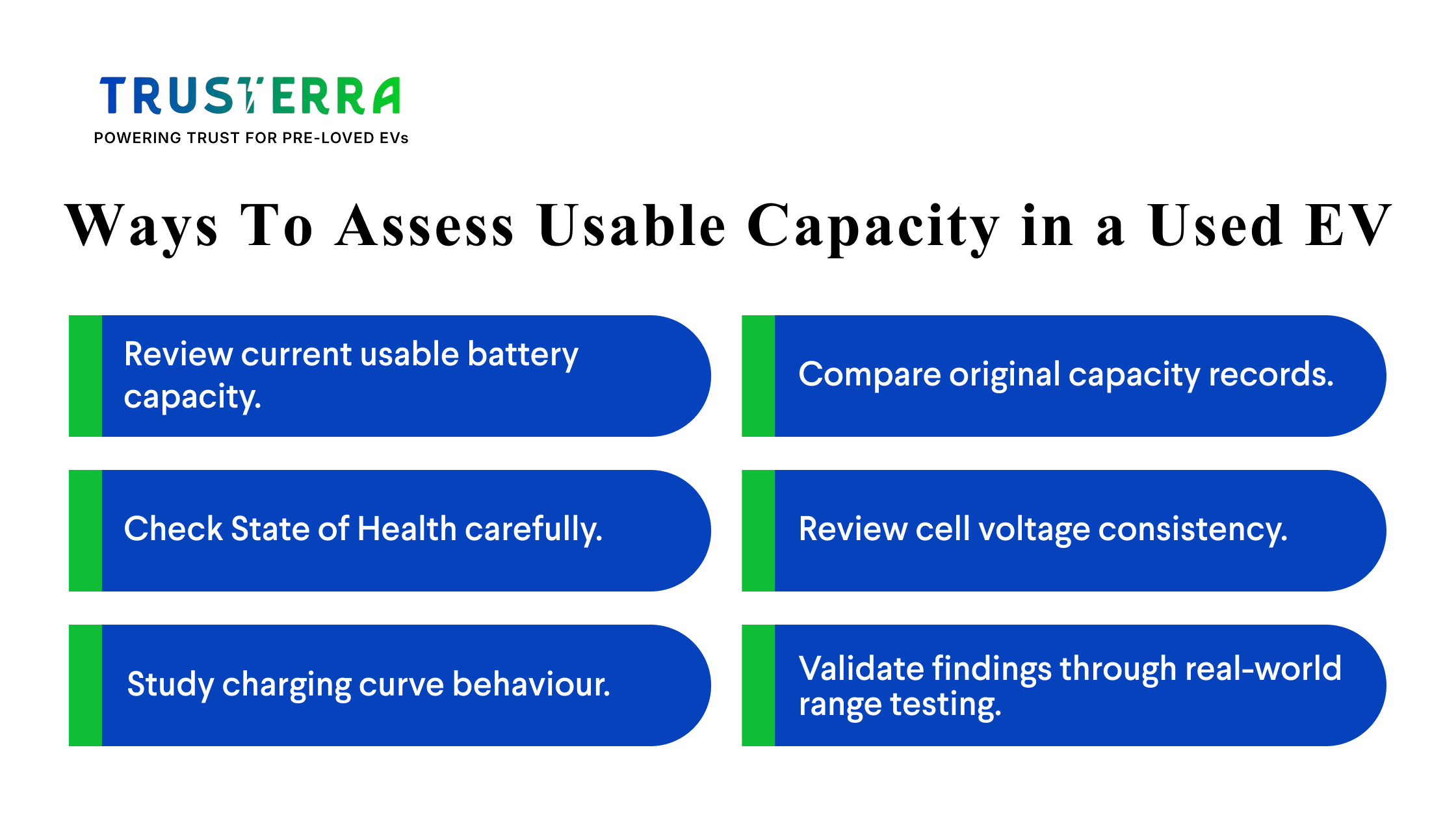
Used EV buyers cannot estimate the battery buffer from the dashboard. The buffer is configured within the battery system and is not a buyer-facing resale metric. A proper inspection should instead measure usable capacity, SoH, charging response, and real-world range evidence.
- Current usable capacity: Compare current usable capacity with the original usable capacity for that vehicle model. This helps show how much driving energy remains available inside the operating threshold.
- State of Health: SoH gives a clearer view of battery condition during resale. It helps buyers understand whether capacity loss has affected the vehicle’s practical range and price.
- Cell voltage consistency: Cell voltage behaviour helps show whether cell groups are operating evenly. Wider differences may point to ageing, imbalance, or weaker battery management.
- Charging curve behaviour: A healthy pack usually follows a predictable charging curve. Unusually early tapering can suggest heat limits, ageing, or battery protection activity.
- Real-world range validation: A practical range test helps confirm that diagnostic readings align with daily usability. This protects buyers from relying only on dashboard numbers.
How does buffer size affect used EV pricing and negotiation?
Buffer size affects original battery design, but used EV pricing should not depend on assumptions about remaining buffer. The buffer remains a protection margin. Pricing should focus on current usable capacity, SoH, charging behaviour, real-world range, and warranty status.
- Usable capacity evidence: Current usable capacity is the key pricing signal because it shows how much energy remains available for driving. Buyers should value the EV based on usable capacity, not assumed buffer depletion.
- SoH-led negotiation: SoH helps buyers understand battery ageing in a resale context. A lower SoH can support price correction when it affects range, charging confidence, or future ownership comfort.
- Seller value defence: Sellers with strong battery evidence can defend the asking price more credibly than with full-charge screenshots. A verified report makes the value story easier to trust.
- Range-based confidence: Real-world range evidence shows whether the EV still meets practical driving needs. This matters more to buyers than the theoretical buffer configured by the manufacturer.
- Financing relevance: Lenders may treat usable capacity and battery health as collateral signals. Stable range and strong SoH can support stronger valuation confidence during used EV financing.
How does TrusTerra help buyers understand battery capacity buffer?
We help buyers understand battery capacity buffer by separating design-level battery protection from current resale-relevant battery evidence. The buffer protects cells from over-utilisation, while usable capacity shows what the battery can deliver today.
The TruEV Score™ reads usable capacity, thermal history, and charging behaviour as part of our wider trust layer. TerraScan supports diagnostic checks that reveal battery condition signals where vehicle access permits. These inputs help valuation reflect current usable capacity rather than assumptions about buffer usage.
We also help sellers, dealers, lenders, and buyers work with the same battery evidence. Assured Buyback and Lock Your Price can support clarity of future value where applicable.
Book a free consultation with TrusTerra to check usable battery capacity and understand the real condition of a used EV before purchase.