


What is Battery Calendar Ageing in EVs?
Understand battery calendar ageing in EVs, how time alone reduces capacity, and what used EV buyers in India should check. Read on to learn more.
Battery Calendar Ageing
Battery calendar ageing is the gradual loss of battery health over time. It can occur even when the EV is parked, unused, or driven very little. Researchers link calendar ageing with storage temperature and State of Charge, especially in lithium-ion batteries.
For used EV buyers, this term matters because a low-kilometre EV is not always a low-risk EV. A vehicle parked for long periods at high charge in hot weather can still lose capacity. This is why age, storage behaviour, and SoH must be checked together.
TrusTerra addresses this problem by focusing on battery-led trust rather than surface-level vehicle checks. Our marketplace highlights AI-driven valuation that accounts for battery health and software signals. That makes calendar ageing a useful input for used EV pricing and resale confidence.
Key Takeaways
|
What does battery calendar ageing mean in an EV?
Battery calendar ageing means battery health declines over time due to storage conditions and chemical changes. It can happen even when the EV is not being driven. The main drivers are usually temperature, charge level, battery chemistry, and the duration the battery remains under stress.
- Time-based loss: Battery calendar ageing occurs as cells sit for months or years of storage. A used EV can lose capacity even when the odometer reading looks low.
- Heat exposure: High temperatures can accelerate side reactions within battery cells. In hot Indian cities, parking and charging habits can shape long-term battery health.
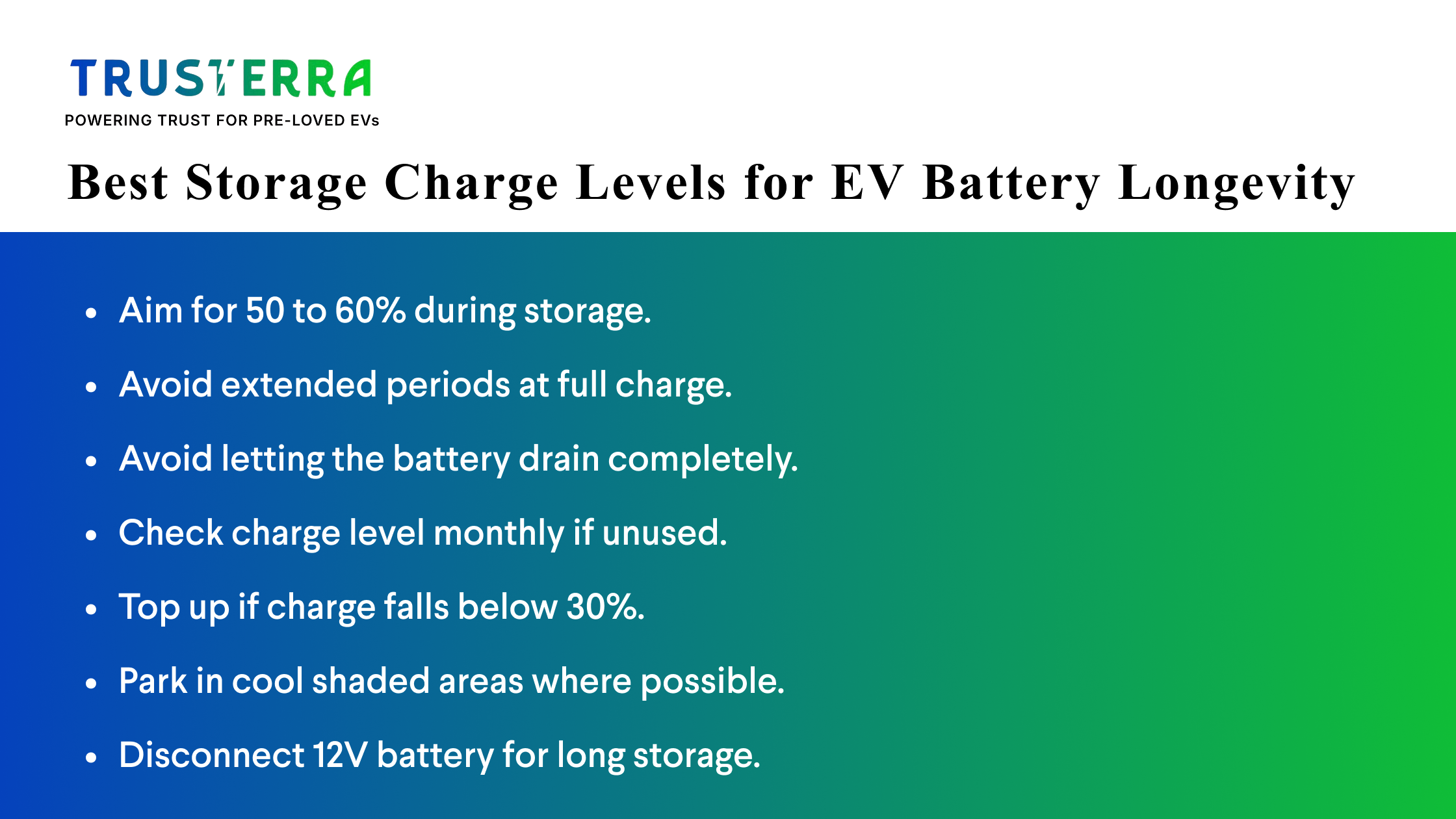
- Charge-level stress: Batteries kept near full charge for long periods can face higher stress. This is why long storage at high State of Charge needs careful review.
- Buyer relevance: A buyer should not judge battery health by age or kilometres alone. A verified SoH check provides stronger evidence of current usable capacity.
How is battery calendar ageing different from battery cycle ageing?
Battery calendar ageing and battery cycle ageing describe two different paths of battery wear. Calendar ageing is time-led, while cycle ageing is use-led. A used EV can suffer from both, which is why battery reports should include age, usage, SoH, and charging behaviour.
Difference | Battery calendar ageing | Battery cycle ageing |
Main cause | Time, storage temperature, and charge level. | Driving, charging, and discharge cycles. |
Happens when parked | Yes, even without regular driving. | Mostly during battery use and recharge. |
Buyer clue | Low kilometres may still hide ageing. | High usage often shows stronger wear. |
Key driver | Heat and high storage SoC matter. | Depth of discharge and current matter. |
Resale impact | Affects low-use and stored EVs. | Affects fleet and heavy-use EVs. |
Why does battery calendar ageing matter in India?
Battery calendar ageing matters in India because many EVs face high temperatures, outdoor parking, and irregular charging routines. Heat and high charge storage can add stress over time. A lightly used EV may still need careful battery checks before purchase.
- Low kilometres can mislead buyers when the EV has spent long periods parked at high charge.
- Hot parking conditions add stress because battery chemistry reacts faster under elevated temperature exposure.
- Idle fleet vehicles need checks since stored commercial EVs may age without earning kilometres.
- High SoC storage can weaken confidence when the seller cannot explain charging habits during long idle periods.
- Verified battery reports reduce doubt by showing present SoH instead of relying on age or claims.
What factors speed up battery calendar ageing?
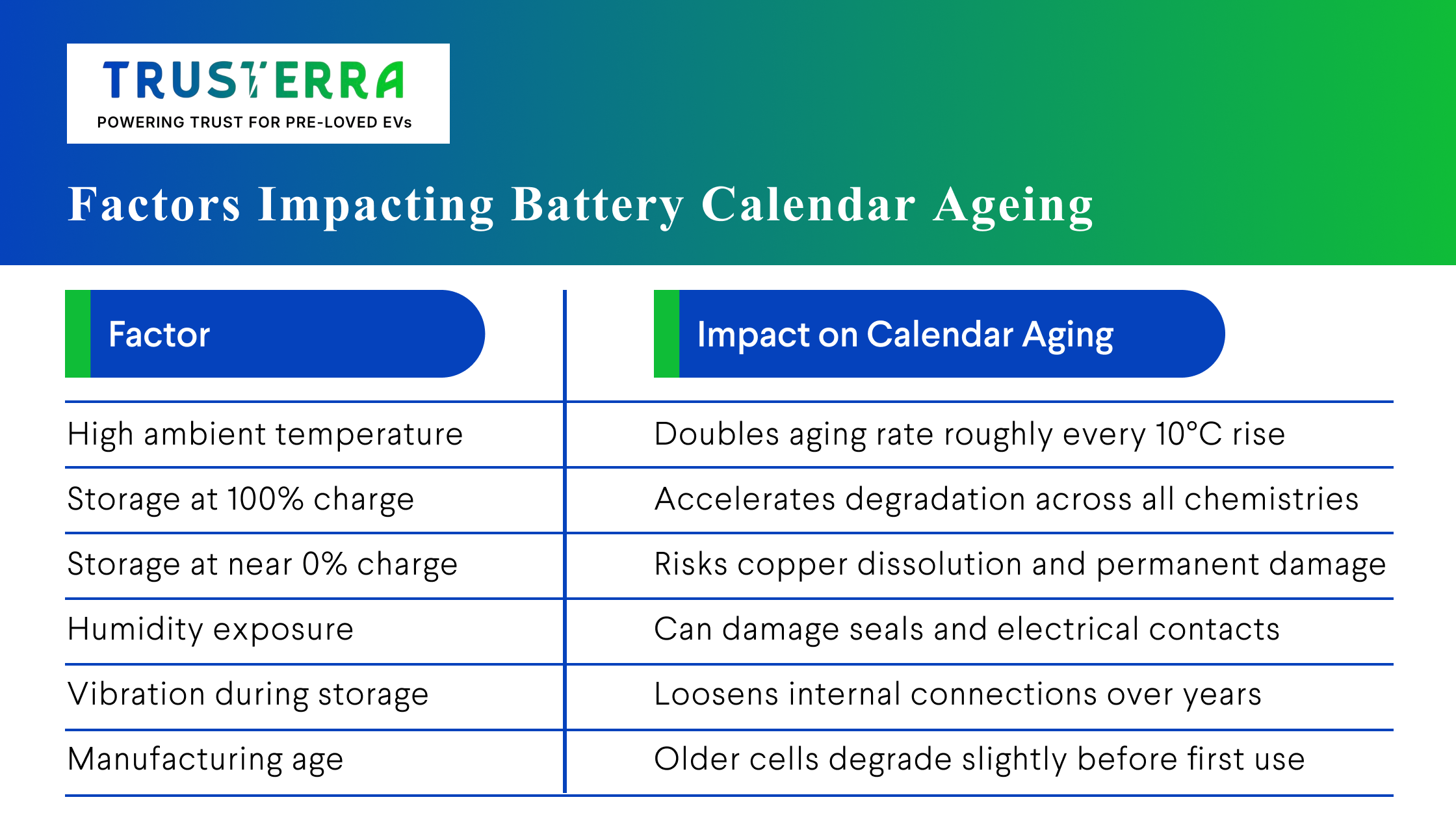
Battery calendar ageing can speed up when a battery stays hot, remains highly charged, or sits unused for long periods. Battery chemistry and pack management also affect the pace. Reviews of lithium-ion ageing show strong links between temperature, SoC, and storage degradation.
- High State of Charge: A battery kept near full charge for long storage can age faster. Buyers should ask whether the EV was stored at moderate charge or kept topped up.
- High temperature: Heat can accelerate chemical side reactions within battery cells. This matters for EVs parked outdoors, charged in peak heat, or stored in hot regions.
- Long idle periods: An EV that sits unused for months can still lose usable capacity. Storage history matters most when the vehicle has low kilometres but older registration.
- Battery chemistry: LFP, NMC, and NCA batteries do not age in exactly the same way. Buyers should read chemistry with SoH and usage history, not in isolation.
How can used EV buyers detect battery calendar ageing?
Used EV buyers can detect battery calendar ageing by comparing registration age, battery SoH, odometer reading, and storage history. A low-mileage EV with poor SoH can indicate time-related degradation. The buyer should request diagnostics before trusting the listed price.
- Check SoH: State of Health shows current usable capacity and gives a clearer battery signal. It helps buyers spot ageing that kilometres alone may hide.
- Ask about storage history: Sellers should explain any long idle periods, storage charge levels, and parking conditions. Missing answers create risk when the EV is older.
- Review charging pattern: Regular full-charge storage can raise battery stress over time. Buyers should ask whether the EV was left plugged in for extended periods.
- Inspect the warranty status: The battery warranty can reduce future exposure if coverage remains valid. Buyers should check transfer rules, remaining time, and kilometre limits.
How does battery calendar ageing affect resale value?
Battery calendar ageing affects resale value because it can reduce usable range without heavy driving history. Buyers pay for present battery confidence, not only low kilometres. If the SoH is weak for the vehicle's age, the asking price may need to be corrected.
A low-use EV can still command a fair price when battery evidence is strong. Clean SoH, clear storage records, warranty support, and stable range behaviour can reduce buyer hesitation. This helps sellers defend their value with proof rather than persuasion.
A poorly stored EV may face deeper negotiation even if the exterior looks clean. Buyers worry about future range loss and replacement exposure. That is why battery calendar ageing needs to be included in every serious used EV valuation.
How does TrusTerra help assess battery calendar ageing?
TrusTerra helps users read battery calendar ageing through the wider lens of health, value, and resale readiness. Its TruEV Score™ evaluates battery health, range consistency, and remaining useful life for used EV decisions. This gives buyers and sellers a clearer signal of trust.
For buyers, this reduces the risk of trusting low kilometres without battery proof. For sellers, it helps explain why a well-maintained EV warrants a higher price. For dealers and financiers, it creates a more consistent way to compare used EVs.
Battery calendar ageing is time-led, but resale confidence is evidence-led. TrusTerra helps make that evidence easier to understand before a transaction. Book a TrusTerra inspection and get your TruEV Score™ before the deal closes.