


C-Rate Meaning for Used EV Battery Buyers
Learn what C-rate means in EV batteries, how it affects charging speed, heat, battery ageing, range confidence, and used EV value.
C-rate
C-rate describes how quickly an EV battery charges or discharges relative to its rated capacity. A 1C rate means a full charge or discharge happens in about one hour, while 0.5C takes about two hours. Buyers use it to understand charging stress, performance demand, and battery ageing risk.
For used EV buyers, c-rate matters because battery stress is not shaped by kilometres alone. A battery used at higher charge or discharge rates can face more heat and faster wear. This is why charging patterns, driving load, and SoH must be reviewed together.
TrusTerra’s used EV trust layer makes this term more practical for buyers and sellers. Its valuation approach accounts for battery health and software signals, while the platform also mentions 200+ data points for EV valuation. This helps users move from technical terms to clearer resale decisions.
Key takeaways:
|
What does C-rate mean in an EV battery?
C-rate is the rate at which a battery charges or discharges relative to its rated capacity. A 1C discharge means the battery could discharge in about one hour under defined conditions. A lower C-rate means slower energy movement and usually less battery stress.
- Simple meaning: C-rate compares battery current with battery capacity, so buyers can understand energy movement speed. A 50 Ah battery discharging at 50 A is working at 1C under simple calculation.
- Charging view: The charging C-rate indicates how quickly current enters the battery during charging. Higher c-rate charging can save time, although heat and battery management still decide safety.
- Discharge view: Discharge C-rate indicates how quickly the EV draws power while driving. Hard acceleration, payload load, and hill routes can raise discharge demand.
- Used EV view: C-rate helps explain how the battery was stressed over its ownership period. It should be read with SoH, charging history, and temperature behaviour.
How is C-rate related to charging speed, charger power, and battery capacity?
C-rate is the battery’s charging or discharging speed relative to its capacity. It tells how fast current moves into or out of the battery compared with what the battery can hold. Charger power may be shown in kW, while battery capacity for C-rate calculation is measured in ampere-hours, or Ah.
Difference | C-rate or charging speed | Charger power | Battery capacity |
Main meaning | Shows how fast the battery charges or discharges relative to its capacity. | Shows the absolute power supplied by the charger in kW. | Shows how much charge the battery can hold in Ah. |
Common unit | Expressed as 0.5C, 1C, 2C, or another C-rate value. | Expressed in kilowatts, such as 25 kW or 50 kW. | Expressed in ampere-hours for C-rate calculation. |
Buyer question | How fast is the battery being charged or discharged? | How much power can the charger deliver? | How much charge can the battery store? |
Stress signal | Higher C-rate can create more heat and battery stress. | High kW can mean different stress across battery sizes. | Battery size affects how the same power feels to the pack. |
Used EV role | Helps explain charging strain and driving load history. | Helps assess charging convenience and charger compatibility. | Helps calculate C-rate and understand battery scale. |
This distinction helps buyers avoid a common misunderstanding. C-rate is charging speed from the battery’s point of view, while kW is charger power from the charging system’s point of view. The same 50 kW charger can create a higher C-rate in a smaller battery and a lower C-rate in a larger battery.
Why does C-rate matter for used EV buyers?
C-rate matters because it explains how hard the battery worked during charging and driving. Two EVs with the same number of kilometres can have different battery stress levels. The buyer should check usage patterns, fast charging frequency, battery heat, and SoH before trusting the price.
- Higher c-rate charging can add stress when fast charging is repeated during hot weather or weak cooling conditions.
- Higher discharge demand can affect fleets because payload, steep routes, and daily use increase battery load.
- Lower c-rate use can support comfort when charging habits stay moderate and thermal systems work well.
- C-rate history needs battery evidence because sellers may not remember charging and driving stress clearly.
- TruEV Score™ adds useful context by reading battery conditions beyond age, kilometres, and surface inspection.
How does high C-rate affect battery heat and ageing?
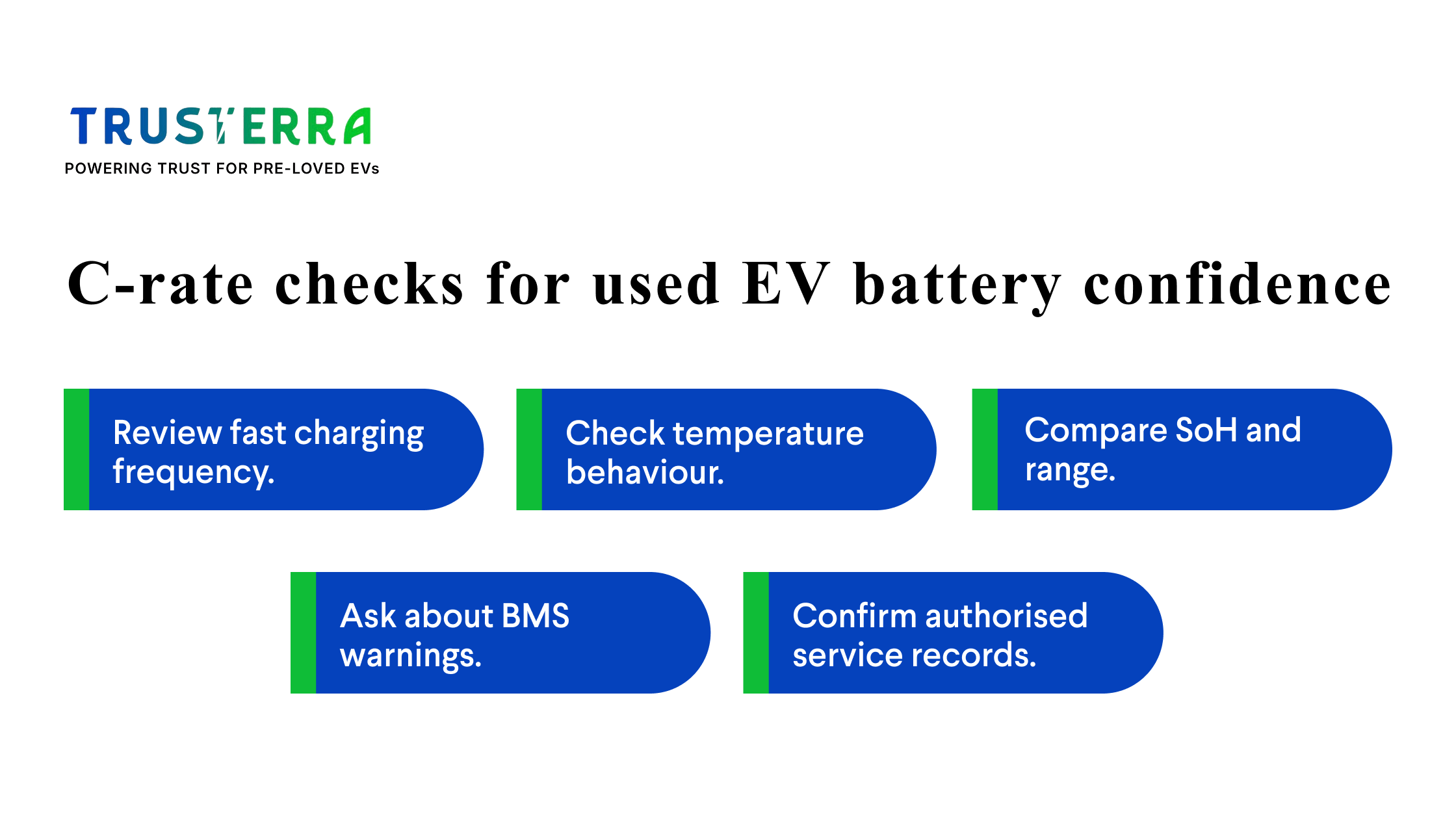
A high C-rate can increase heat because current flows faster through the battery. Excess heat can increase chemical stress if the battery cooling system cannot manage it effectively. NREL battery ageing work considers charge and discharge rate, temperature, and operating window as degradation factors.
- Heat generation: Higher current can create more internal heat inside cells. This does not mean every fast charge is harmful, but repeated exposure to heat requires attention.
- Ageing pressure: High c-rate use can add to cycle ageing when combined with deep discharge. The impact becomes stronger when heat and high State of Charge overlap.
- Cooling dependence: A strong thermal management system can reduce c-rate stress during fast charging. Poor cooling may make the same charging pattern more harmful.
- Resale effect: Buyers may discount EVs with a heavy fast-charging history and poor battery health. Verified diagnostics can separate normal use from risky usage patterns.
How does C-rate affect fast charging and daily range?
C-rate affects fast charging because a larger battery can often accept more power at the same relative rate. A 100 kW charger may stress a small battery more than a large battery. That is why kW alone does not explain battery stress.
Fast charging usually starts faster when the battery is at lower State of Charge. It slows near the top because the BMS protects cells from excess stress. Buyers should ask whether the EV fast charges smoothly without repeated warnings.
The daily range is affected when high c-rate use causes long-term capacity loss. The driver may not notice any stress during a single charge session. Over years, repeated high-stress use can reduce SoH and weaken resale confidence.
What C-rate signals should buyers check in battery reports?
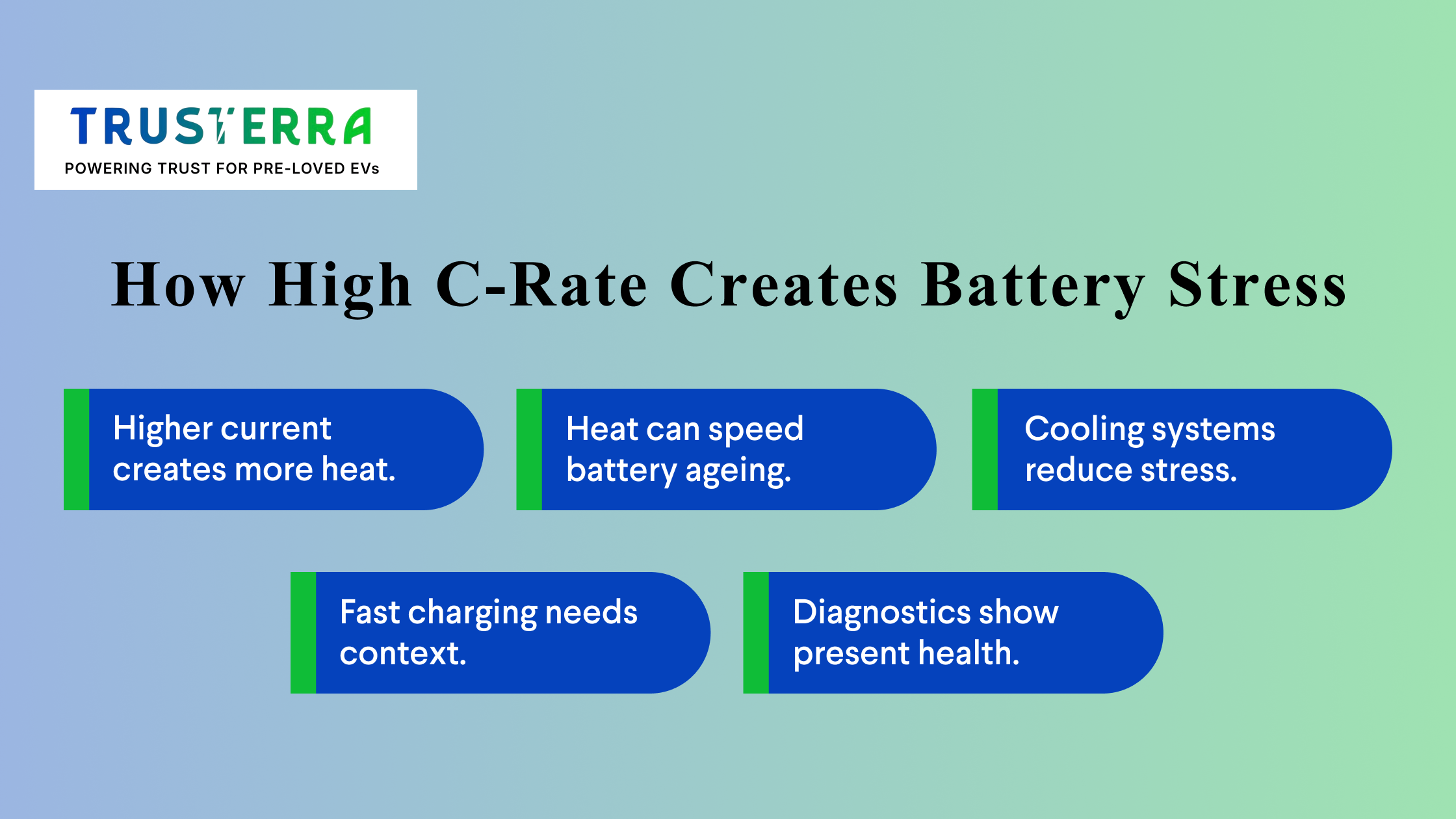
Buyers should not expect every report to show the exact historical c-rate for every charge event. They should still look for signs of high-current stress. Charging logs, BMS alerts, thermal behaviour, and SoH can explain how the battery handled usage.
- Fast charging frequency: Frequent fast charging can lead to higher c-rate exposure over the ownership period. The concern rises when it combines with heat, deep discharge, or weak battery health.
- Battery temperature behaviour: Temperature logs can show whether the pack managed heat under high current. Repeated heat alerts deserve closer review before buying.
- SoH and range: State of Health reflects the current effects of ageing and stress. Range behaviour then helps confirm whether the battery still serves daily needs.
- BMS warning history: Battery management system alerts can reveal protection events or unusual charging behaviour. Buyers should ask whether warning events were repaired through authorised service.
How does C-rate affect fleet EV resale?
C-rate affects EV resale in fleets because fleet vehicles often face higher daily battery demand. Delivery routes, payload use, and repeated charging can create stronger charge or discharge stress. Buyers assess whether the EV can still perform its work without range loss or downtime.
- Fleet buyers check earning ability because battery stress affects route completion and daily revenue.
- High utilisation can raise cycle stress when vehicles charge often and run long delivery windows.
- Payload can increase discharge demand because the motor draws more current during loaded trips.
- Route type affects battery strain when steep roads or stop-start traffic create repeated current demand.
- Verified scoring supports batch resale because buyers need consistent evidence across multiple similar EVs.
How does TrusTerra help interpret C-rate in used EV decisions?
TrusTerra helps interpret C-rate by placing charging and driving stress inside a wider battery health picture. The platform does not expect buyers to decode technical signals alone. It connects battery behaviour with SoH, range confidence, resale readiness, and transaction trust.
TruEV Score™ helps buyers, sellers, dealers, and financiers understand the condition of used EVs through clearer battery intelligence. It can support pricing, negotiation, and finance conversations with more evidence. This matters because c-rate only becomes useful when linked to present battery condition.
A used EV should be judged by how its battery behaves today. C-rate explains one part of that journey, while TrusTerra helps connect the evidence. Get TruEV Score™ before buying, selling, or financing a used EV.