


Is Buying a Used EV Worth It in India 2026?
Takeaways:
- Used EVs cost 30% to 45% less than new.
- Running costs stay lower than petrol vehicles.
- Battery health decides long-term ownership value.
- Warranty transfer terms vary across manufacturers.
- Charging access at home improves daily practicality.
- Verified inspection reduces used EV purchase risk.
- Market resale standards are still developing.
In FY2026, India's passenger EV market grew an impressive 83.63%, with retail registrations totalling 1,99,923 units. This growth means more pre-owned electric cars are entering the resale market every quarter. For buyers watching prices, a used EV now sits within the budget range of a new petrol hatchback or compact SUV.
Yet the question remains: is buying a used EV worth it in a market that still lacks common resale standards? Battery health, warranty coverage, charging access and pricing benchmarks all need separate attention compared to a petrol vehicle purchase.
This blog covers the real advantages, trade-offs and decision factors for anyone considering a pre-owned electric car in India in 2026.
Why Are Buyers Considering Used Electric Cars in India?
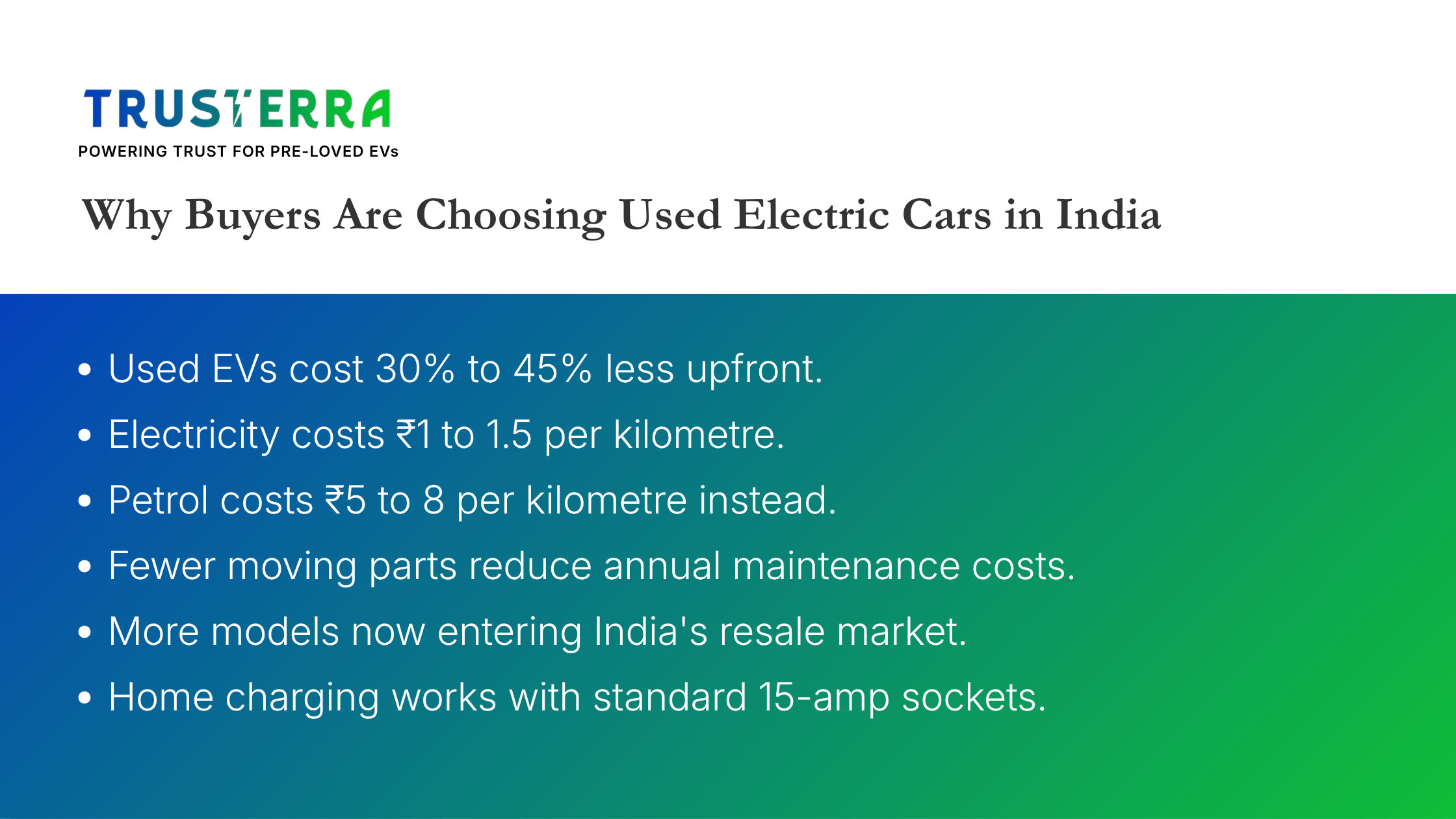
Buyers are considering used electric cars because of lower purchase prices, reduced running costs and growing model availability. The new-to-used EV pipeline has expanded as early adopters upgrade to longer-range models. This creates more supply for budget-conscious buyers who want electric mobility without the showroom price.
- Lower entry price: A two- to three-year-old Tata Nexon EV sells for ₹8 to 12 lakh in the used market, compared with ₹12 to 17 lakh new. That 30% to 40% reduction brings electric car ownership within reach of a wider buyer base.
- Running cost advantage: Electricity costs ₹1 to 1.5 per kilometre in most Indian cities. Petrol costs ₹5 to 8 per kilometre for a comparable hatchback. Over 12,000 kilometres a year, a used EV saves ₹48,000 to ₹78,000 on fuel alone. Lower maintenance adds another ₹5,000 to ₹7,000 in annual savings because electric vehicles have fewer moving parts, no engine oil changes and no exhaust system servicing.
- More models entering resale: Early batches of the Tata Nexon EV, MG ZS EV, Hyundai Kona Electric and Tata Tiago EV are now two to four years old. Owners upgrading to newer versions like the Nexon EV 45 kWh or Curvv EV are releasing well-maintained vehicles into the used market.
Growing charging access: India had over 29,000 public EV charging stations installed by early 2026. Metro cities like Bengaluru, Delhi, Mumbai, Hyderabad and Pune now have denser charger networks. Home charging remains the most practical option for daily use, and most Indian homes with dedicated parking can support a standard 15-amp socket or wall-mounted AC charger.
What Are the Real Financial Benefits of Buying a Used EV?
A used EV saves money at purchase, on daily running and on annual maintenance compared to both new EVs and petrol equivalents. The financial advantage compounds over three to four years of ownership. You keep the electric powertrain's cost efficiency while avoiding the first-owner depreciation hit.
| Cost Factor | Used EV (2-3 Yrs Old) | New Petrol Car (Same Budget) |
| Purchase price | ₹5 – 12 Lakh | ₹7 – 14 Lakh |
| Fuel/charging cost per km | ₹1 – 1.5 | ₹5 – 8 |
| Annual fuel/charging cost (12,000 km) | ₹12,000 – 18,000 | ₹60,000 – 96,000 |
| Annual maintenance | ₹3,000 – 8,000 | ₹8,000 – 15,000 |
| Insurance (renewal) | Comparable | Comparable |
Over a three-year ownership period covering 36,000 kilometres, a used EV buyer can save ₹1.4 to 2.3 lakh in fuel and maintenance costs compared to a petrol vehicle. That gap widens for buyers who drive more than 15,000 kilometres per year or commute in stop-and-go city traffic, where EVs perform at peak efficiency.
The first owner absorbs the steepest depreciation. Used EV buyers enter at a 30% to 45% lower price point, yet they inherit the same powertrain efficiency. This makes the total cost of ownership attractive even when accounting for the eventual battery warranty expiry.
What Are the Risks You Should Know Before Buying a Used EV?
Buying a used EV carries specific risks that petrol cars do not present. Battery degradation, warranty gaps, software issues and limited resale benchmarks are the main concerns. Understanding these risks upfront helps you price them into your purchase decision.
- Battery degradation: Every EV battery loses capacity over time. Geotab's 2025 study of over 22,700 EVs found the average battery retains 81.6% of original capacity after eight years. In Indian conditions with higher ambient temperatures, degradation can be faster. A battery at 75% SoH delivers noticeably less range than what the original spec promised.
- Warranty coverage gaps: Most Indian EV manufacturers offer an 8-year or 1,60,000-kilometre battery warranty. On resale, the warranty transfers to the second owner in most cases. However, terms can change. Tata's lifetime warranty for first owners reverts to standard 8-year coverage on resale. If the previous owner missed scheduled services at authorised centres, the warranty may already be void.
- Limited resale benchmarks: Used EVs in India retain around 40% to 55% of their original price after three years. Petrol vehicles retain 55% to 65% over the same period. The gap exists because buyers still hesitate around battery uncertainty and the market lacks a common used EV certification standard.
- Software dependency: Some used EVs run outdated firmware that limits range, charging speed or connected features. If the manufacturer has stopped supporting a particular software version, the vehicle may not receive future updates.
How To Decide If a Used EV Is Right for You?
The decision depends on your daily driving distance, charging access at home, budget flexibility and comfort with battery-related risk. A used EV works well for specific ownership profiles. It may not suit every buyer.
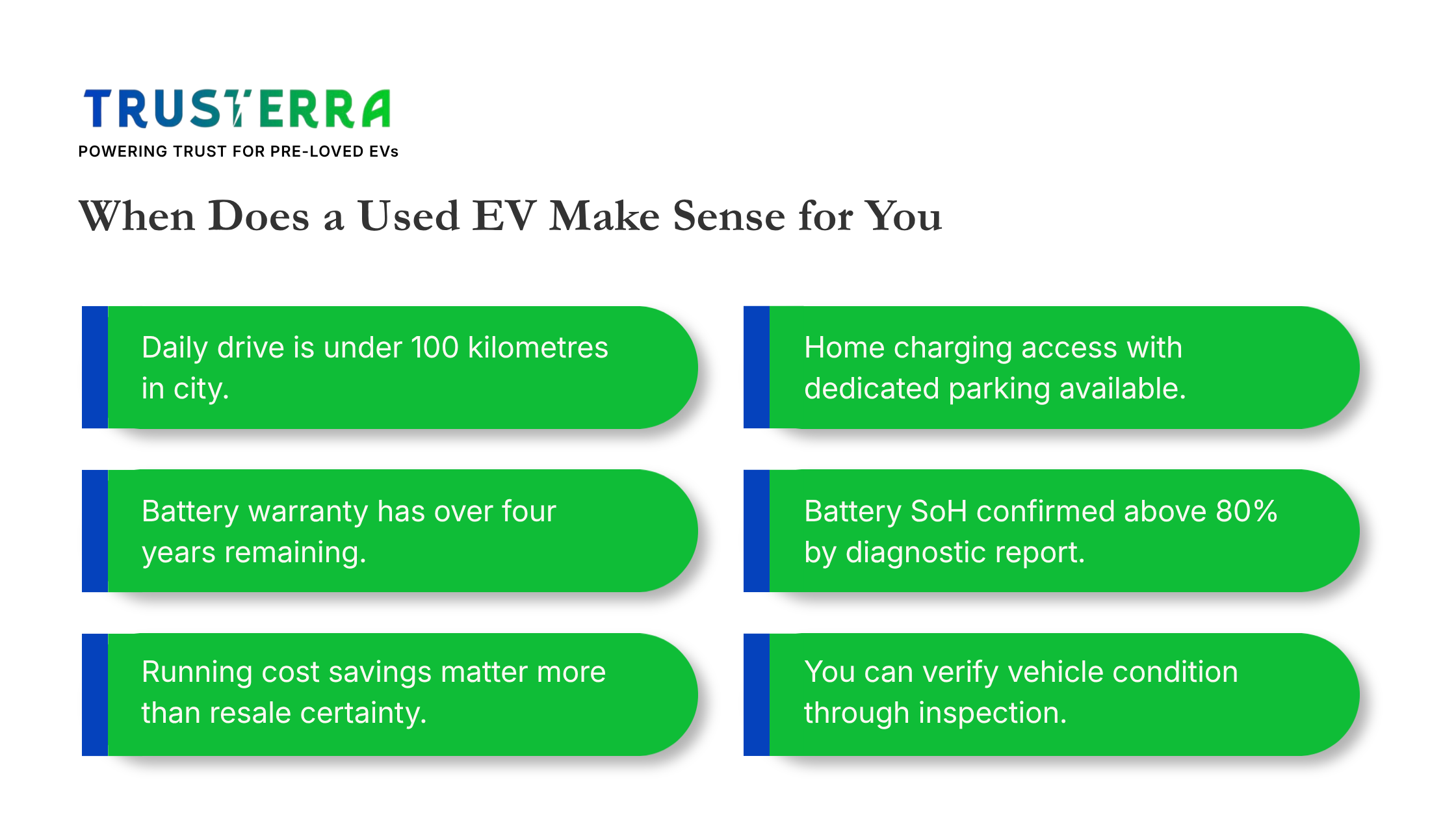
A used EV makes sense if:
- Your daily driving stays under 100 kilometres across city or suburban routes.
- Home charging gives you predictable access through a dedicated parking spot.
- Lower running costs matter across three to four years of ownership.
- The battery warranty still covers more than four years of usage.
- A diagnostic report confirms battery SoH above the 80% mark.
- The available range comfortably supports your regular travel after battery degradation.
A used EV may not suit you if:
- Your weekly travel depends heavily on long-distance highway driving.
- Your apartment parking does not allow EV charger installation.
- The battery warranty has expired or has less than two years left.
- The seller cannot provide a verified battery health report before purchase.
- You need predictable resale value for a trade-in within two years.
The decision framework is simple. If your use case aligns with the strengths of electric ownership and the vehicle passes battery health and warranty checks, a used EV is likely worth it. If the gaps outweigh the savings, a new petrol vehicle may be the safer choice for now.
How Does Trusterra Help You Make a Confident Used EV Decision?
Trusterra removes the guesswork from used EV buying by providing AI-powered valuation across more than 200 data points. The TruEV™ Score assesses battery health, remaining range and useful life in a single reference number. Doorstep inspection, documentation support and secure payment processing make the transaction safer and more transparent.
For buyers asking whether a used EV is worth it, Trusterra answers that question with data instead of opinions. The platform evaluates the specific vehicle you are considering, not a generic model average. This means you see the real condition, fair price and remaining warranty status before you commit.
If you are exploring the used EV market, start by understanding how battery health shapes your purchase. Read our complete guide here or get in touch with our team.