


How to Check EV Battery Health Before Buying
Takeaway:
- State of Health measures remaining battery capacity.
- Request a diagnostic report from the authorised centre.
- Manufacturer apps show battery health on some models.
- A 30-kilometre test drive reveals real range behaviour.
- Charging history affects degradation more than age alone.
- Hot climates in India accelerate battery capacity loss.
- TrueV™ Score by Trusterra quantifies battery condition.
The battery pack is the most expensive component in an electric vehicle. It is also the part that determines how far the vehicle can travel on every charge. When buying a used EV, battery health is the first thing you should evaluate, ahead of kilometres driven, paint condition or interior wear.
Yet most used EV buyers in India do not know how to check EV battery health in a reliable way. The dashboard range estimate is not a health indicator. Kilometres on the odometer do not tell you how the battery was treated. You need specific diagnostic data to understand the real condition of the pack.
This guide covers every method available to Indian buyers for checking battery health on a used EV, from manufacturer tools to independent diagnostics and practical road tests.
What Is State of Health and Why Does It Matter for Used EVs?
State of Health tells you how much usable battery capacity an EV still has compared with its original capacity. It is different from charge percentage. Charge shows the current battery level, while SoH shows long-term battery ageing.
For a used EV buyer, SoH works like a battery condition report. A clean car with low kilometres can still have weaker battery health. That weakness can affect real-world range, future usability and the buyer’s comfort with the deal.
SoH also helps provide better context when comparing two similar EVs. One EV may have fewer kilometres, while another may have stronger battery health. The better choice depends on verified battery condition, charging history and actual range behaviour.
That is why SoH should guide the price discussion, not only the purchase decision. A used EV with 88% SoH can still be a strong city car. A lower SoH may still work, but it needs price correction, warranty checks and deeper diagnostics.
Why Does Battery Life Matter for Used EV Resale Value?
Battery life matters for used EV resale value because it shows how much useful ownership remains for the next buyer. Once SoH gives a snapshot of present battery condition, battery life helps buyers understand future range, cost exposure and resale confidence.
Used EV resale is different from petrol vehicle resale. Petrol car buyers focus heavily on engine condition, service history and mechanical wear. Used EV buyers need proof that the battery can still deliver predictable range for daily use.
This is where battery reports, warranty papers and scoring systems become valuable. They reduce the gap between what the seller claims and what the buyer can trust. A seller with verified battery data can also defend the asking price with more confidence.
Here is how battery life shapes EV resale value:
- Stronger SoH: Higher SoH shows that the battery still retains useful capacity. It can support better range confidence and stronger resale value.
- Stable range: Buyers trust EVs that deliver predictable range across daily use. Range consistency matters more than one best-case range claim.
- Active warranty: An active battery warranty reduces future repair fear. It can also make the vehicle more acceptable to buyers and lenders.
- Clean service records: Service records show battery care, software updates and repair history. They reduce doubt during price negotiation.
- Useful remaining life: A battery with clear remaining life gives the next buyer practical value. That value directly affects resale confidence.
How Can You Check Battery Health Using Manufacturer Tools?
You can check battery health on most Indian EVs through the manufacturer's mobile app, the in-car diagnostic screen or an authorised service centre report. Each method gives you a different level of detail. Start with the app and confirm the reading with a service centre visit.
- Tata EV (Nexon EV, Tiago EV, Punch EV): The Tata EV mobile app shows battery health data including SoH percentage for connected vehicles. You can request a detailed battery diagnostic report from any Tata authorised EV service centre. This report includes SoH, cell voltage balance, thermal history and charging pattern data.
- MG Motor (ZS EV, Comet EV): The iSMART app provides battery health indicators for connected MG vehicles. For a detailed SoH reading, visit an MG authorised service centre and request a battery diagnostic scan. The scan takes 30 to 60 minutes depending on the model.
- Hyundai (Kona Electric): Hyundai's Bluelink app shows battery status data. A full battery health report requires a visit to the authorised service centre. The technician connects to the vehicle's onboard diagnostic (OBD) port and generates a detailed cell-level report.
- General rule for all brands: Do not rely on the seller's verbal claim about battery health. Request the diagnostic report yourself by visiting or calling the authorised service centre directly. If the seller resists this step, treat it as a red flag.

Can You Test EV Battery Health Without a Diagnostic Report?
You can estimate battery health using a practical range test if a diagnostic report is unavailable. This method gives a rough comparison between the vehicle's current range behaviour and its original specification. It does not replace a proper SoH reading, but it helps identify obvious problems.
- Step 1: Charge to 100%: Charge the vehicle to full capacity using a standard AC charger. Note the range displayed on the dashboard at 100% charge.
- Step 2: Drive 30 kilometres in mixed conditions: Drive in a mix of city streets and open roads at normal speed. Use climate control if you would use it in daily driving. Do not hypermile or drive at unusually low speeds.
- Step 3: Compare range drop to distance covered: After 30 kilometres, check the remaining range on the dashboard. If the range dropped by more than 40 kilometres for 30 kilometres of actual driving, the battery may have significant capacity loss or a calibration issue.
- Step 4: Compare the full-charge range to the ARAI-rated range: If the vehicle originally offered 312 kilometres of ARAI-rated range and now shows 220 kilometres at full charge, the effective range loss is roughly 30%. That suggests SoH may be in the 70% to 75% range, which is near the warranty floor.
This test is useful but imperfect. Ambient temperature, driving style, terrain and tyre condition all affect range. Treat it as a screening tool, not a final verdict. A service centre diagnostic should follow if the numbers raise concern.
What Factors Cause EV Battery Degradation in Indian Conditions?
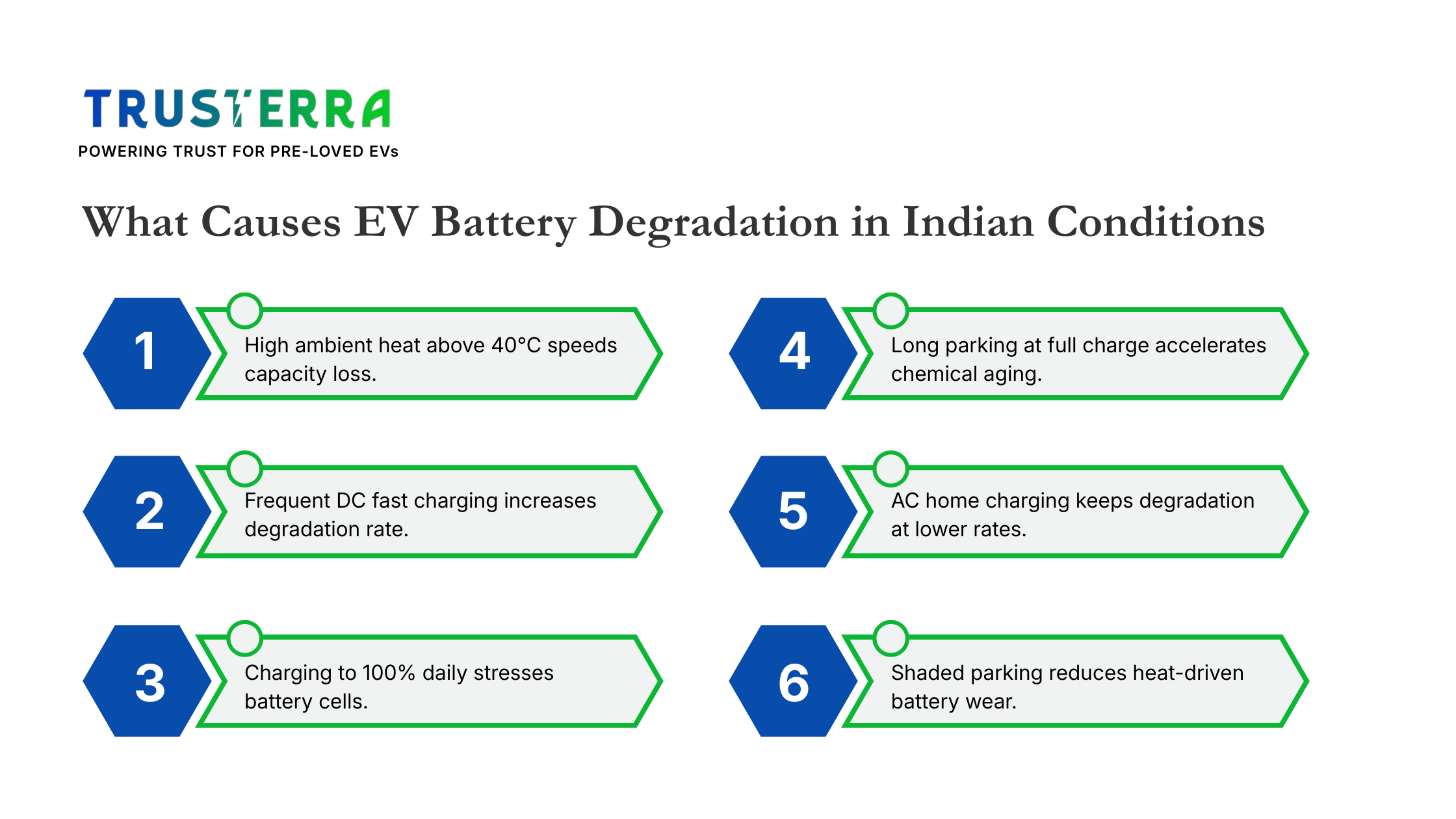
EV Battery degradation in India follows the same chemistry as anywhere else, yet local conditions accelerate certain patterns. Knowing these factors helps you ask the right questions about a used EV's history.
- Heat exposure: Lithium-ion batteries degrade faster in sustained high temperatures. Cities like Delhi, Nagpur, Chennai, Hyderabad and Jaipur experience extended summer periods above 40°C. An EV parked in direct sunlight at full charge for hours every day will lose capacity faster than one garaged or parked in shade.
- DC fast charging frequency: A 2025 study found that vehicles using DC fast charging for more than 12% of total sessions degrade at up to 3% per year. Vehicles charged mostly on AC degrade at around 1.5% per year. Ask the seller how often the vehicle used DC fast chargers. If the vehicle served as a ride-hailing car with frequent fast charging, expect higher degradation.
- Charging to 100% regularly: Keeping a lithium-ion battery at 100% charge for extended periods stresses the cells. Most manufacturers recommend charging to 80% for daily use and reserving 100% for long trips. If the previous owner charged to full every night, the battery may show more wear than its age suggests.
- Long periods of inactivity at high charge: An EV parked at 100% charge for weeks without use also accelerates degradation. This pattern is common among second-car owners who drive their EV only on weekends.
How Does Trusterra Help You Verify Battery Health Before Buying?
Trusterra provides a structured battery health assessment through its TrueV™ Score. The score evaluates SoH, remaining range capacity and useful battery life across more than 200 data points. This gives buyers a single reference number instead of guesswork around how to check EV battery health.
The platform's doorstep inspection means you do not need to coordinate separate visits to a service centre and the seller's location. Trusterra's assessment covers battery condition, vehicle exterior, cabin electronics, software version, charging port condition and document verification in one visit.
For buyers who want to understand how battery health shapes the vehicle's real value, the TrueV™ Score connects SoH data to fair market pricing. Two vehicles of the same model and age can carry different values depending on battery condition. Trusterra makes that difference visible before you commit.
Get in touch with our team to get your used EV's TruEV™ Score from Trusterra before you buy.